
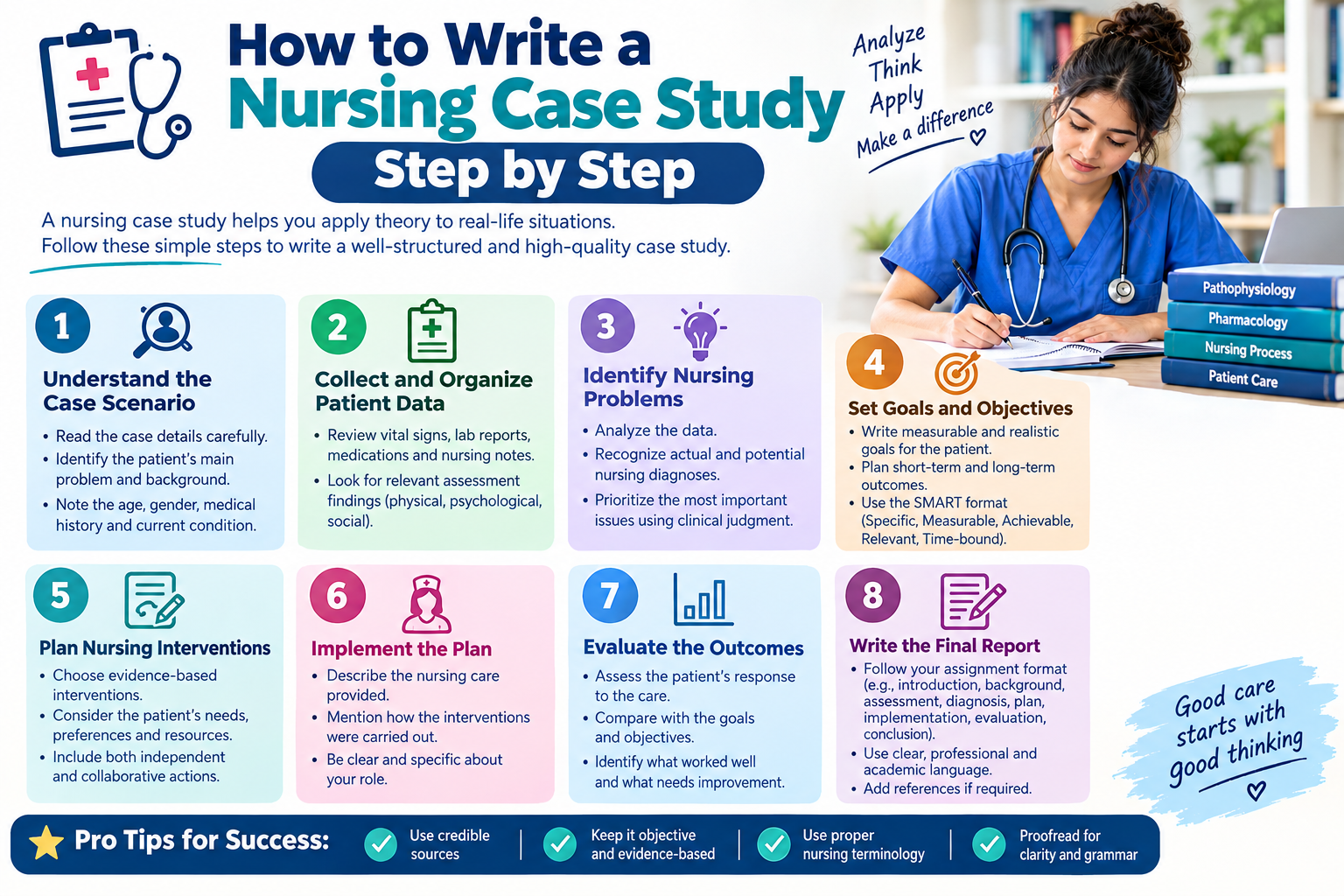
A nursing case study is one of the most common and valuable assignments in nursing education. It requires you to examine a real or hypothetical patient scenario in depth, apply nursing theory and evidence-based practice, demonstrate clinical reasoning, and show how nursing care can improve patient outcomes. Unlike a general essay, a case study is applied and practical. It mirrors the thinking process nurses use every day: assessing a patient, identifying problems, planning care, implementing interventions, and evaluating results.
This step-by-step guide explains exactly how to write a high-quality nursing case study. It covers preparation, research, structure, writing techniques, analysis, and final checks. Follow these steps carefully and you will produce work that is clear, evidence-based, patient-centred, and academically rigorous.
Understanding What a Nursing Case Study Is
A nursing case study is a detailed examination of a patient (or group of patients) that explores health issues, nursing assessments, diagnoses, interventions, and outcomes. It usually includes:
- A description of the patient’s background and presenting problem
- Relevant pathophysiology or psychosocial factors
- Comprehensive nursing assessment data
- Prioritised nursing diagnoses
- A plan of care with goals and interventions
- Evaluation of care
- Critical discussion linking theory, evidence, and practice
- Reflections on learning or implications for future practice
Case studies may be based on real patients (always fully anonymised), simulated scenarios provided by tutors, or published cases. The purpose is to develop clinical reasoning, apply the nursing process, and demonstrate the ability to integrate evidence into care.
Step 1: Analyse the Assignment Brief Thoroughly
Before writing anything, study the assignment instructions carefully.
Identify:
- The exact requirements (word count, structure, specific model or framework to use)
- Whether the case is provided or whether you must choose one
- Learning outcomes the work must address
- Marking criteria (knowledge, analysis, application, structure, referencing)
- Required referencing style (usually APA 7th edition)
- Any mandatory sections or headings
- Deadline and submission format
Note the command words. “Analyse,” “discuss,” “evaluate,” and “critically appraise” require more than description. You must examine why certain findings matter, compare options, and justify decisions with evidence.
If anything is unclear, contact your tutor early. Clarifying expectations at the start prevents wasted effort later.
Step 2: Select or Receive the Patient Case
If the case is provided by your tutor, read it several times and highlight key information: age, gender, medical history, presenting complaint, vital signs, assessment findings, social circumstances, and any investigations or treatments already mentioned.
If you must choose a case (for example from clinical placement), select one that:
- Has sufficient complexity to allow meaningful analysis
- Relates to the module learning outcomes
- Allows discussion of nursing (not purely medical) interventions
- Can be fully anonymised to protect confidentiality
Always protect patient identity. Change names, ages (slightly), dates, locations, and any unique identifying details. Never include real hospital numbers, photographs, or identifiable information.
Step 3: Gather Information and Conduct Research
A strong case study rests on accurate clinical knowledge and current evidence.
Collect case data systematically
Organise the available information under headings such as:
- Biographical and social details
- Presenting complaint and history of present illness
- Past medical, surgical, and medication history
- Family and social history
- Physical assessment findings (including vital signs)
- Psychological and emotional status
- Investigations and results
- Current treatments and multidisciplinary input
Research the relevant clinical knowledge
Search for:
- Pathophysiology of the main condition(s)
- Current clinical guidelines (NICE, national or specialty nursing guidelines)
- Evidence-based nursing interventions
- Best practice for assessment and monitoring
- Patient education and self-management strategies
- Potential complications and how to prevent them
- Psychosocial or cultural considerations
Use reliable databases: CINAHL, PubMed, Medline, Cochrane Library, and Google Scholar. Prefer sources published within the last 5–10 years unless historical context is required. Keep a research log and record full references as you go.
Apply critical appraisal
Ask of every source: Is the evidence high quality? Is it relevant to this patient population? Are there limitations? How does it inform nursing care?
Step 4: Choose an Appropriate Framework or Model
Most nursing case studies are organised around a recognised framework. Common choices include:
- The Nursing Process (Assessment, Diagnosis, Planning, Implementation, Evaluation)
- Gordon’s Functional Health Patterns
- Roper-Logan-Tierney Model of Nursing (Activities of Living)
- Orem’s Self-Care Deficit Theory
- Maslow’s Hierarchy of Needs (for prioritisation)
- Specialty-specific models (for example, in mental health or palliative care)
Select the model required by the brief or the one that best fits the patient’s needs and the module focus. State clearly which framework you are using and why it is appropriate.
Step 5: Create a Detailed Outline
Before writing the full draft, prepare a clear outline. A typical nursing case study structure includes:
- Title page (if required)
- Introduction
- Patient background / case presentation
- Pathophysiology or relevant clinical background (if needed)
- Nursing assessment
- Nursing diagnoses (prioritised)
- Planning / Goals of care
- Implementation / Nursing interventions (with rationales)
- Evaluation
- Discussion / Critical analysis
- Conclusion
- Reference list
- Appendices (if used, for example full care plan tables)
Allocate approximate word counts to each section so the final piece remains balanced.
Step 6: Write the Case Study Section by Section
Introduction
Briefly introduce the purpose of the case study. State the main health issue or focus. Outline the structure of the paper and name the nursing framework you will use. Keep this section concise (approximately 5–10% of the total word count).
Patient Background / Case Presentation
Present the anonymised patient details in a clear, professional narrative. Include relevant history, presenting problem, and significant findings. Write objectively and respectfully. Avoid unnecessary or sensational detail.
Pathophysiology or Clinical Background
Explain the underlying disease process or health issue in a way that is accurate yet accessible. Link the pathophysiology directly to the assessment findings you will discuss. Support explanations with current evidence.
Nursing Assessment
Present a comprehensive assessment using your chosen framework. Include subjective data (what the patient reports) and objective data (what you observe or measure). Organise findings logically. Highlight abnormal or significant results and explain their clinical importance.
Nursing Diagnoses
Identify actual and potential nursing diagnoses using recognised terminology (for example NANDA-I). Prioritise them according to urgency and patient need (often using Maslow or ABC approach). For each diagnosis, provide a brief rationale linking assessment data to the diagnostic statement.
Planning and Goals of Care
Set SMART goals (Specific, Measurable, Achievable, Relevant, Time-bound) for the priority diagnoses. Goals should be patient-centred and realistic. Include both short-term and longer-term goals where appropriate.
Implementation and Nursing Interventions
Describe the nursing interventions you would (or did) carry out. For every intervention, provide a clear evidence-based rationale. Explain why the action is appropriate for this patient, citing guidelines or research. Include collaborative care with other professionals, patient education, and safety measures. Address holistic needs—physical, psychological, social, and spiritual—where relevant.
Evaluation
Discuss how you would evaluate whether the goals have been met. Describe expected outcomes, assessment methods, and what you would do if goals are not achieved. If the case is based on real experience, reflect on actual outcomes and any modifications made to the plan.
Discussion and Critical Analysis
This is often the highest-weighted section. Move beyond description. Critically examine the care provided or planned. Discuss strengths and limitations of the approach. Compare your interventions with current evidence and guidelines. Consider alternative options and justify your choices. Address ethical, cultural, or resource-related issues. Explore implications for interprofessional working and continuity of care. Demonstrate deep clinical reasoning.
Conclusion
Summarise the key points of the case without introducing new information. Restate the main nursing priorities and the importance of evidence-based, patient-centred care. Highlight any learning points or recommendations for practice. End with a clear closing statement.
Step 7: Apply Strong Academic Writing Style
- Write in clear, formal, professional language.
- Use the third person for most of the case study (first person is acceptable in reflective elements if the brief allows).
- Be precise and objective. Avoid emotional or judgemental language.
- Integrate evidence smoothly with correct citations.
- Maintain a patient-centred tone throughout.
- Use accurate nursing and medical terminology.
- Ensure logical flow between sections with clear linking sentences.
Step 8: Reference Accurately and Maintain Academic Integrity
Cite every source of information that is not common knowledge. Follow the required style guide precisely (usually APA 7th). Include a complete reference list. Paraphrase carefully and use direct quotations sparingly. Protect patient confidentiality rigorously—this is both an ethical and academic requirement.
Step 9: Review, Edit, and Proofread
After completing the first draft:
- Check that every section addresses the assignment brief and learning outcomes.
- Confirm that analysis is critical rather than purely descriptive.
- Verify that all interventions have clear, evidence-based rationales.
- Ensure the structure is logical and balanced.
- Check word count and formatting.
- Proofread carefully for grammar, spelling, punctuation, and clarity.
- Read the work aloud or use text-to-speech to catch awkward phrasing.
- Confirm all citations match the reference list.
Leave time between writing and final editing so you can review with fresh eyes. Use any available university writing or academic skills support.
Common Mistakes to Avoid
- Providing only a medical description instead of a nursing-focused analysis
- Listing interventions without evidence-based rationales
- Failing to prioritise nursing diagnoses
- Using outdated sources or low-quality evidence
- Neglecting psychosocial, cultural, or ethical aspects
- Poor anonymisation that risks identifying the patient
- Weak critical discussion that stays at a descriptive level
- Inconsistent or incomplete referencing
- Ignoring the required framework or structure
Practical Tips for Success
Start early and work systematically through each step. Keep detailed notes and a running reference list. Use tables for care plans if permitted—they improve clarity and organisation. Always link findings and interventions back to the individual patient rather than writing generically. Demonstrate holistic thinking and interprofessional awareness. After receiving feedback, reflect on what worked well and what can be improved for future case studies.
Conclusion
Writing a nursing case study is a structured process that develops essential clinical reasoning skills. By carefully analysing the brief, gathering accurate data and evidence, applying a suitable nursing framework, writing clearly and critically, and reviewing thoroughly, you can produce a case study that is both academically strong and clinically meaningful.
Follow the steps in this guide, remain focused on the patient, and ground every decision in current evidence. With practice, case study writing becomes a powerful tool for learning and a direct preparation for the complex, thoughtful care required in professional nursing practice.