
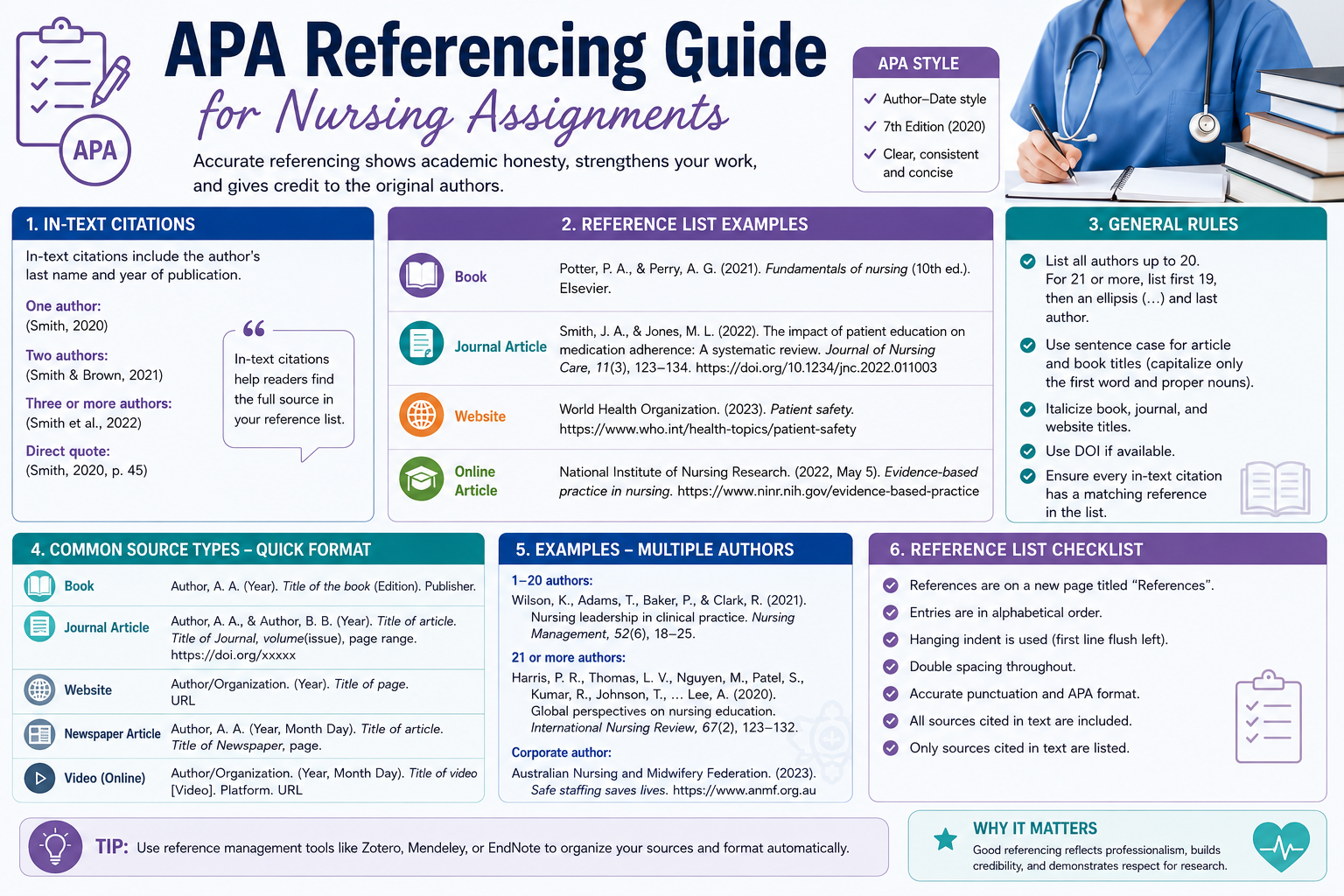
Referencing errors are one of the most common — and most avoidable — reasons nursing students lose marks. APA (American Psychological Association) style is the standard referencing format for most nursing programs, and while the rules are learnable, they're detailed enough that small mistakes creep in easily: a missing publication year, an inconsistent reference list format, or an in-text citation that doesn't match its full reference. This guide covers exactly how APA referencing works for nursing assignments, using the current APA 7th edition standard.
Unlike disciplines where referencing is largely a formality, nursing markers tend to scrutinize reference lists closely, because the reference list is effectively an audit trail for every clinical claim in the assignment. A marker who spots a formatting inconsistency often checks that source more carefully — which means referencing errors don't just cost marks on their own, they can also draw closer scrutiny to the content those references are supposed to support. Getting the mechanics right protects the credibility of everything else in the essay.
Why APA Referencing Matters More in Nursing
In most academic disciplines, a referencing error is a minor deduction. In nursing, correct referencing is tied directly to the credibility of clinical claims. Every dosage figure, guideline recommendation, or physiological value you state needs to be traceable to a credible, verifiable source — and APA formatting is how you make that traceability clear to a marker checking your evidence base.
Beyond the academic stakes, referencing correctly is also professional practice. Nurses are expected to base clinical decisions on current evidence and to be able to justify those decisions by pointing to where the evidence came from. Learning to reference properly in your assignments is, in a real sense, rehearsal for that expectation later in clinical practice.
There's also a practical exam-hall reason APA matters: most nursing programs run plagiarism-detection software on submissions, and inconsistent or missing citations can trigger false-positive similarity flags even when the underlying work is entirely original. A properly cited paraphrase is clearly attributed and distinguishable from copied text; a poorly cited or uncited paraphrase can look, to detection software and to a human marker, indistinguishable from unattributed copying. Correct referencing protects you from that ambiguity as much as it credits your sources.
The Two Core Components of APA Referencing
APA referencing has two parts that must always match each other exactly: in-text citations, which appear within your writing wherever you use a source, and the reference list, a full alphabetical list of every source cited, placed at the end of your assignment.
Every source cited in-text must have a corresponding entry in the reference list, and every entry in the reference list must be cited somewhere in the text. A reference list entry with no matching in-text citation, or an in-text citation with no matching reference list entry, is a common and easily avoidable error markers specifically check for.
In-Text Citations: The Basics
APA in-text citations use an author-date format. The two main styles are:
Parenthetical citation — the author and year appear in brackets at the end of the sentence or clause: Effective hand hygiene significantly reduces hospital-acquired infection rates (Smith, 2023).
Narrative citation — the author's name is part of the sentence itself, with only the year in brackets: Smith (2023) found that effective hand hygiene significantly reduces hospital-acquired infection rates.
Both formats are correct APA style — which one you use depends on whether you want to emphasize the source (narrative) or the information itself (parenthetical). Nursing assignments often benefit from varying between the two, since using only one style repeatedly across a 2500-word assignment can feel monotonous to read.
A related point worth stressing: an in-text citation is not permission to closely mirror the original source's wording without quotation marks. Paraphrasing means genuinely rewriting the idea in your own words and sentence structure, not swapping a few words in an otherwise identical sentence. Close paraphrasing that stays too near the original phrasing is treated as a form of plagiarism by most institutions' academic integrity policies, even when a citation is present — the citation attributes the idea, but it doesn't excuse copying the structure or wording.
Citing Sources With Multiple Authors
- One author: (Smith, 2023)
- Two authors: (Smith & Jones, 2023) — always use an ampersand (&) inside parentheses, and "and" when written narratively (Smith and Jones, 2023)
- Three or more authors: (Smith et al., 2023) — list only the first author's surname followed by "et al." for all sources with three or more authors, from the very first citation
Citing a Direct Quote
Direct quotes should be rare in nursing writing, since paraphrasing is the expected norm and demonstrates genuine understanding of the material. When a direct quote is genuinely necessary — because the exact wording carries specific technical or legal weight — APA requires a page number in addition to the author and year:
(Smith, 2023, p. 45)
If the source has no page numbers, such as many web-based sources, use a paragraph number or section heading instead:
(Smith, 2023, para. 3)
Keep direct quotes short. Anything approaching 40 words or more in APA style requires a block quote format, which is rarely appropriate in a nursing assignment and should generally be avoided in favor of paraphrasing.
Citing Organizational or Guideline Sources
Nursing assignments frequently cite guidelines from organizations rather than individual authors — NICE, WHO, or a national nursing regulatory body, for example. Use the full organization name on first citation, and you may introduce an abbreviation for subsequent citations:
First citation: (National Institute for Health and Care Excellence [NICE], 2023) Subsequent citations: (NICE, 2023)
Citing Multiple Sources in One Citation
When a claim is supported by more than one source, list them together in the same parentheses, separated by semicolons, in alphabetical order:
(Jones, 2022; Smith, 2023)
Building the Reference List
The reference list appears on its own page at the end of the assignment, titled "References" (not "Bibliography," which implies sources you consulted but didn't necessarily cite — APA reference lists only include sources actually cited in the text).
Reference list entries are formatted with a hanging indent: the first line of each entry sits at the left margin, and subsequent lines are indented. Entries are listed alphabetically by the first author's surname.
Journal Article Format
Author, A. A. (Year). Title of the article in sentence case. Title of the Journal in Title Case, Volume(Issue), page range. https://doi.org/xxxx
Example: Smith, J. R. (2023). Hand hygiene compliance and hospital-acquired infection rates. Journal of Clinical Nursing, 32(4), 512–520. https://doi.org/10.1234/jcn.2023.0456
Key details to get right: the article title uses sentence case (only the first word and proper nouns capitalized), while the journal title uses title case (major words capitalized). The journal name and volume number are italicized; the issue number is not.
This is one of the most frequently misapplied rules in student reference lists, largely because it's counterintuitive — most students default to capitalizing every major word out of habit, which is correct for the journal title but wrong for the article title. When building your reference list, deliberately check each entry against this rule individually rather than assuming consistency across entries you copied from different sources, since different databases and citation generators often format these inconsistently.
Book Format
Author, A. A. (Year). Title of the book in sentence case (edition if not first). Publisher.
Example: Taylor, C. (2022). Fundamentals of nursing: The art and science of person-centered care (10th ed.). Wolters Kluwer.
Book Chapter Format
Author, A. A. (Year). Title of the chapter. In E. E. Editor (Ed.), Title of the book (pp. page range). Publisher.
Website or Online Guideline Format
Organization or Author. (Year, Month Day if available). Title of the page. Site Name. URL
Example: National Institute for Health and Care Excellence. (2023). Type 2 diabetes in adults: Management. NICE. https://www.nice.org.uk/guidance/ng28
If no individual or clear organizational author exists and no date is available, use "n.d." in place of the year, but treat this as a last resort — sources without clear authorship or dates are generally weak choices for a nursing assignment in the first place.
Common APA Mistakes in Nursing Assignments
The mistakes below account for the large majority of referencing deductions seen across nursing assignments. Most are quick to fix once you know to look for them specifically, which is exactly why a dedicated referencing check — separate from a general proofread — is worth the extra time before submission.
Mismatched in-text citations and reference list entries. This happens most often when a source is cited in a draft, then removed or replaced during editing without updating the reference list to match, or vice versa. Before submitting, cross-check every in-text citation against the reference list one by one.
Inconsistent capitalization. Mixing up sentence case (for article titles) and title case (for journal and book titles) is one of the most frequent formatting slips, largely because it's easy to lose track of which rule applies where across a long reference list.
Missing the DOI or URL. Journal articles increasingly require a DOI (Digital Object Identifier) where one exists; if no DOI is available, a direct URL to the source is the next best option. Omitting both makes a source harder to verify and looks like an incomplete reference.
Using "et al." incorrectly. A frequent error is using "et al." for sources with only two authors — APA 7th requires both names to be listed for two-author sources, reserving "et al." for three or more.
Secondary referencing without flagging it. Citing a source you only encountered quoted inside another source — rather than reading the original — should be avoided wherever possible. If genuinely unavoidable, APA requires you to flag it explicitly: (Smith, 2019, as cited in Jones, 2023), and only the source you actually read (Jones, 2023) appears in your reference list.
Alphabetizing errors. Reference lists must be strictly alphabetical by first author surname. It's easy to lose track of correct ordering when adding or removing sources during editing — recheck the full list's order as a final step before submission.
Formatting the reference list with bullet points or numbers. APA reference lists are not bulleted or numbered; entries are simply separated by the hanging indent and listed in alphabetical order.
Inconsistent date formatting for sources without a clear year. When a source genuinely has no identifiable publication date, APA requires "n.d." (no date) in place of a year, formatted identically wherever it appears — (Smith, n.d.) in-text and Smith, J. (n.d.) in the reference list. Students sometimes leave the date blank or write "unknown" instead, which isn't correct APA format and stands out immediately to a marker checking references carefully.
Treating retrieval dates as always required. Under APA 7th edition, a retrieval date is only needed for web sources that are likely to change over time, such as a wiki or a frequently updated webpage without version control — most journal articles, formal reports, and stable guideline pages don't need one. Adding retrieval dates to every web source out of habit is a minor but noticeable inconsistency with current APA 7th edition rules, which relaxed this requirement compared to earlier editions.
A Practical Workflow to Avoid Referencing Errors
The most reliable way to avoid APA errors isn't memorizing every rule perfectly — it's building a workflow that catches mistakes before submission.
Cite as you write, not after. Trying to reconstruct which source supported which claim after the essay is finished is a common source of missing or mismatched citations. Add the citation the moment you use a source, even in early drafts.
Keep a source log from the start of research. For every source you're considering, log the full reference details, the key finding, and why it's relevant to your argument. This means you already have the exact information needed for a correct reference list entry, rather than hunting for a publication year or DOI at the last minute.
Use reference management software carefully. Tools like Zotero, Mendeley, or EndNote can generate APA-formatted references automatically, which saves time — but they're not infallible. Automatically generated references sometimes contain formatting errors, especially with organizational authors or web sources, so always manually check generated entries against the actual APA rules rather than trusting the software blindly.
Do a dedicated referencing pass before submission. Don't rely on catching referencing errors during a general proofread. Go through the assignment specifically checking: every in-text citation has a matching reference list entry, every reference list entry is cited in the text, capitalization and italics are correct throughout, and the reference list is properly alphabetized.
Check your institution's specific requirements. Some nursing programs use APA 7th edition with minor institution-specific variations (for example, differing requirements around running heads or title page formatting). Always check your program's specific style guide alongside the general APA rules, since institutional requirements take precedence over general convention where they differ.
Read the official APA Publication Manual or Style Guide for anything genuinely uncertain. Secondary guides, including this one, are useful for the rules you'll hit most often, but APA has specific guidance for edge cases — multiple works by the same author in the same year, sources with no identifiable author, republished or translated works — that a general guide can't cover exhaustively. When you hit an unusual source type, checking the official guide directly is faster and more reliable than guessing based on the closest example you can find.
Final Thoughts
APA referencing in nursing assignments isn't just a formatting requirement — it's the mechanism by which you demonstrate that your clinical claims are grounded in credible, traceable evidence. Getting it right consistently comes down to habit more than memorization: citing as you research rather than after, keeping accurate records of every source from the start, and running a dedicated referencing check before submission rather than assuming a general proofread will catch every error. Build that habit early in your program, and referencing stops being a source of last-minute stress and becomes a straightforward, almost automatic part of how you write.
It's also worth treating referencing as a skill that compounds across your program rather than a one-off hurdle for each assignment. The habits built early — logging sources as you find them, citing while you write, running a dedicated formatting check before submission — apply identically whether you're writing a 1500-word reflective piece in your first year or a 5000-word dissertation in your final year. Investing time now in getting APA mechanics genuinely correct, rather than approximately correct, pays off across every assignment that follows.