
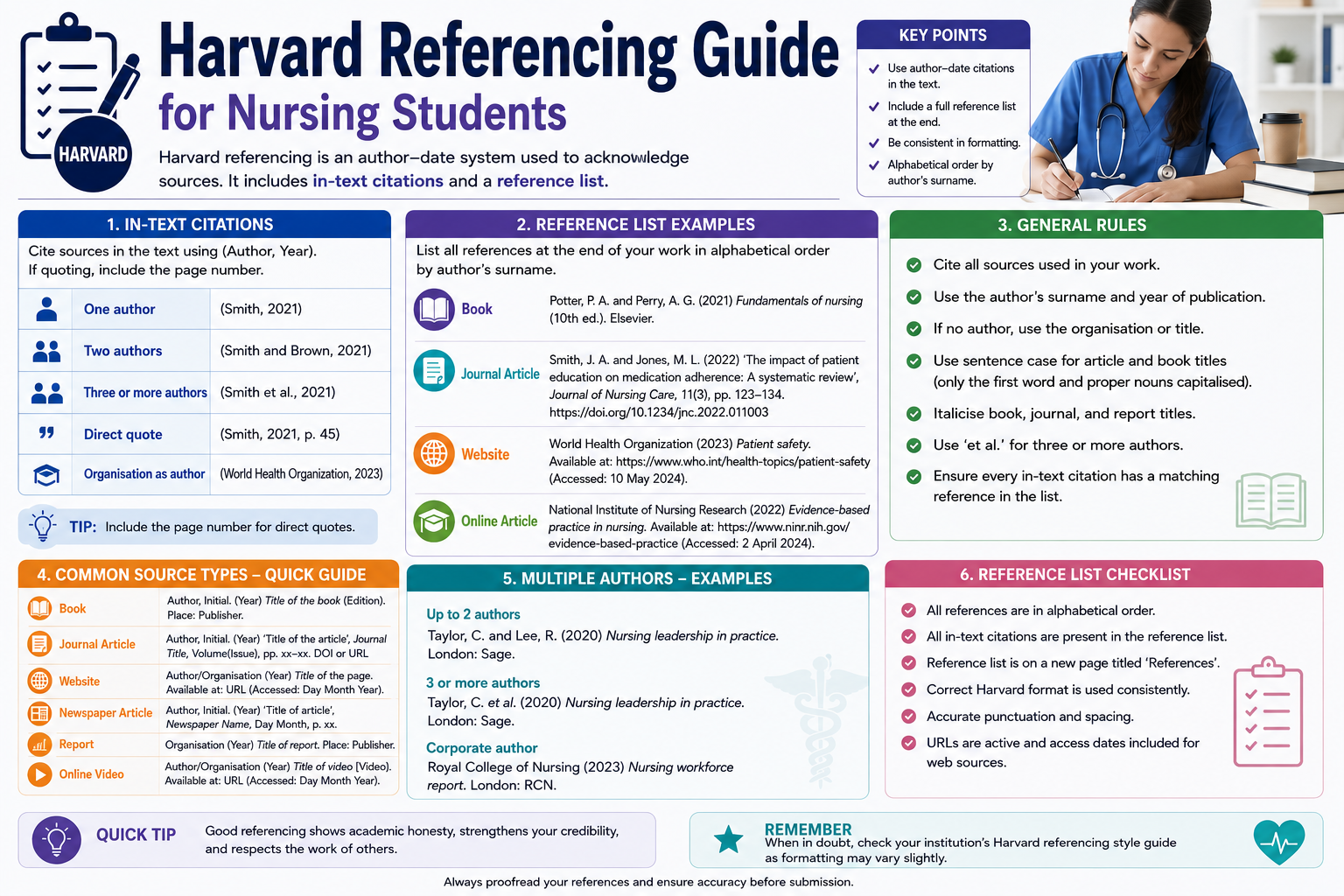
Harvard referencing is the standard citation style at many nursing schools, particularly across the UK, Australia, and parts of Europe. Like APA, it's an author-date system, but the specific formatting rules differ enough that mixing the two up — or applying APA conventions inside a Harvard-required assignment — is a common and entirely avoidable source of lost marks. This guide covers exactly how Harvard referencing works for nursing assignments, including the details that trip students up most often.
Confusion between the two systems is especially common for students who've encountered both across different courses, modules, or even different assignments within the same nursing program. A student who wrote a psychology essay in APA last term and now needs to submit a nursing case study in Harvard style is a genuinely common scenario, and the two systems are similar enough on the surface — both author-date, both requiring an in-text citation matched to a full reference list — that small formatting habits from one style bleed into the other without the student noticing. Knowing the specific points where they diverge is the fastest way to avoid that.
Why Referencing Precision Matters in Nursing
Referencing isn't just an academic formality in nursing — it's the audit trail behind every clinical claim you make. A dosage figure, a guideline recommendation, or a physiological value needs to be traceable back to a credible, verifiable source, and correct referencing is how a marker confirms that traceability at a glance. Beyond the assignment itself, referencing correctly is a rehearsal for professional practice: nurses are expected to base decisions on current evidence and to be able to point to where that evidence came from, and building that habit through consistent, accurate citation now carries directly into clinical documentation later.
It's also worth noting upfront that "Harvard referencing" isn't a single universally fixed standard the way APA is — different institutions publish slightly different Harvard style guides. The core principles covered here are consistent across nearly all versions, but always check your specific institution's style guide for any small variations, particularly around punctuation and formatting details, since your program's guide takes precedence over general convention.
This lack of a single fixed standard is precisely why so many small formatting disputes exist around Harvard style — whether to use a comma between author and year, whether the reference list is called "References" or "Bibliography" or "Reference List," whether accessed dates are mandatory for every web source or only unstable ones. None of these has a single universally correct answer across every institution. The practical solution is not to memorize one "correct" version of Harvard style, but to treat your own institution's published guide as the final authority and apply it consistently throughout every assignment you submit.
The Two Core Components of Harvard Referencing
Like most academic referencing systems, Harvard style has two parts that must always align: in-text citations, placed within your writing wherever you draw on a source, and the reference list, a full alphabetical list of every source cited, placed at the end of the assignment.
Every source cited in-text must appear in the reference list, and every reference list entry must be cited somewhere in the text. A mismatch between the two — a citation with no corresponding reference, or a reference never actually cited — is one of the most common and easily fixed errors markers check for specifically.
In-Text Citations: The Basics
Harvard in-text citations use an author-date format, similar in principle to APA but with some formatting differences.
Parenthetical citation — author and year in brackets at the end of the relevant sentence or clause: Effective hand hygiene significantly reduces hospital-acquired infection rates (Smith 2023).
Narrative citation — the author's name is part of the sentence, with the year in brackets immediately after: Smith (2023) found that effective hand hygiene significantly reduces hospital-acquired infection rates.
Note that Harvard style, unlike APA, typically does not place a comma between the author's surname and the year inside parentheses — though this varies slightly by institution, so check your specific style guide. Some UK institutions do use a comma; when in doubt, follow your program's guide over general convention.
Citing Sources With Multiple Authors
- One author: (Smith 2023)
- Two or three authors: (Smith and Jones 2023), or (Smith, Jones and Patel 2023) — list all authors' surnames, joined with "and" before the final name
- Four or more authors: (Smith et al. 2023) — list the first author's surname followed by "et al." once there are four or more authors, a threshold that differs from APA's three-or-more rule
This four-author threshold is one of the more common points of confusion for students switching between Harvard and APA across different modules — double-check which threshold your specific assignment requires rather than assuming they're identical.
Citing a Direct Quote
Direct quotes should be used sparingly in nursing writing, since paraphrasing in your own words is the expected default and demonstrates genuine understanding rather than transcription. When a direct quote is genuinely warranted, Harvard style requires a page number alongside the author and year:
(Smith 2023, p. 45)
For sources without page numbers, such as many web pages, use a paragraph number or section heading instead where available.
Keep any direct quote short and purposeful. Long quotations rarely belong in a nursing assignment — paraphrase the surrounding context and reserve direct quotation for the rare case where the exact wording itself carries specific technical or clinical significance that paraphrasing would lose.
Citing Organizational or Guideline Sources
Nursing assignments frequently rely on guidance from organizations rather than individual named authors — NICE, WHO, or a national nursing regulatory body, for example. Use the full name on first citation, with an abbreviation introduced for subsequent use:
First citation: (National Institute for Health and Care Excellence [NICE] 2023) Subsequent citations: (NICE 2023)
Citing Multiple Sources in One Citation
When more than one source supports a single claim, list them together within the same parentheses, typically separated by semicolons and ordered either alphabetically or by publication date depending on your institution's preference:
(Jones 2022; Smith 2023)
Building the Reference List
The reference list appears on its own page at the end of the assignment, usually titled "References" or "Reference List" depending on institutional preference — check which term your program expects. Entries are listed alphabetically by the first author's surname, and most Harvard style guides use a hanging indent format similar to APA, though some institutions prefer a flush-left format instead.
Journal Article Format
Author, Initial. (Year) 'Title of the article in single quotation marks', Title of the Journal in Title Case, Volume(Issue), pp. page range.
Example: Smith, J. (2023) 'Hand hygiene compliance and hospital-acquired infection rates', Journal of Clinical Nursing, 32(4), pp. 512–520.
Note the distinctive Harvard convention of placing the article title in single quotation marks — this differs from APA, which uses no quotation marks around article titles. The journal title is italicized and given in title case.
This quotation-mark convention is one of the fastest ways to spot which style a reference list is actually written in, and one of the easiest details to get inconsistent across a long reference list built from sources originally formatted for different citation styles. When copying a reference from a database or citation generator, check specifically whether it applies quotation marks to the article title correctly for Harvard style, since many generators default to APA conventions unless explicitly set otherwise.
Book Format
Author, Initial. (Year) Title of the book in italics. Edition if not the first. Place of publication: Publisher.
Example: Taylor, C. (2022) Fundamentals of nursing: the art and science of person-centred care. 10th edn. Philadelphia: Wolters Kluwer.
Unlike APA, Harvard style typically requires the place of publication alongside the publisher name — a detail students moving between the two systems often forget to include.
Book Chapter Format
Author, Initial. (Year) 'Title of the chapter', in Editor, Initial. (ed.) Title of the book. Place of publication: Publisher, pp. page range.
Website or Online Guideline Format
Organization or Author. (Year) Title of the page in italics. Available at: URL (Accessed: date).
Example: National Institute for Health and Care Excellence (2023) Type 2 diabetes in adults: management. Available at: https://www.nice.org.uk/guidance/ng28 (Accessed: 14 August 2026).
This is one of the clearest differences from APA: Harvard style generally expects an explicit "Accessed" date for online sources, reflecting that web content can change or disappear over time — a requirement APA 7th edition has largely relaxed for stable sources but Harvard style typically retains.
Common Harvard Referencing Mistakes in Nursing Assignments
These mistakes account for the majority of referencing deductions on Harvard-style nursing assignments, and nearly all of them are quick to fix once flagged — which is exactly why a dedicated referencing check, separate from a general proofread, is worth building into your submission routine.
Mixing APA and Harvard conventions within the same assignment. This is the single most common error among students who've studied both styles across different modules. Telltale signs include using a comma between author and year when your institution's Harvard guide doesn't require one, omitting quotation marks around article titles, or forgetting the place-of-publication for books. Before submitting, deliberately check your reference list against your specific institution's Harvard guide rather than a general memory of "author-date" formatting.
Mismatched in-text citations and reference list entries. As with any referencing system, sources cited in the text but missing from the reference list — or vice versa — are an easily avoidable error that a dedicated final check catches reliably.
Getting the multi-author threshold wrong. Applying APA's three-or-more "et al." rule inside a Harvard assignment, where the threshold is typically four or more, results in citations that don't match your institution's actual requirement. Confirm the exact threshold in your specific style guide, since it can vary between institutions even within Harvard-style conventions generally.
Omitting the accessed date for web sources. Because Harvard style typically requires an accessed date for online sources and APA 7th edition mostly doesn't, students moving between the two styles frequently drop this detail from Harvard reference lists out of habit.
Inconsistent italicization. Book and journal titles should be italicized; article and chapter titles should be in single quotation marks, not italicized. Mixing these up, or applying them inconsistently across a long reference list, is a frequent and easily corrected formatting slip.
Secondary referencing without flagging it. Citing a source only encountered quoted inside another source, rather than reading the original, should be avoided wherever possible. If genuinely unavoidable, Harvard style requires this to be explicitly flagged in-text — for example, (Smith 2019, cited in Jones 2023) — with only the source you actually read appearing in the reference list.
Inconsistent ordering within the reference list. Harvard reference lists are alphabetized by first author surname, and it's easy to lose track of correct ordering when sources are added or removed during editing. A quick alphabetical check across the full list is a fast, easily skipped step worth doing as a dedicated pass rather than assuming the order stayed correct throughout drafting.
Citing a source that was never actually read. This is less a formatting error than an academic integrity issue, but it's worth flagging directly: citing a source based only on its abstract, or based on how another paper described it, without reading the actual source, risks misrepresenting what that source says. If you haven't read a source in enough depth to accurately represent its findings, either read it properly before citing it or leave it out.
A Practical Workflow to Avoid Referencing Errors
Cite while you write, not after. Reconstructing which source supported which claim after the essay is finished is one of the most common causes of missing or mismatched citations. Add each citation the moment you use the source, even in an early draft.
Keep a source log throughout your research. For every source you're considering, log the full citation details — author, year, title, publisher or journal, page numbers — along with a note on its relevance. This means the exact information needed for a correct reference list entry is already on hand rather than something you're hunting for the night before submission.
Confirm your institution's exact Harvard variant early. Since Harvard style differs meaningfully between institutions, get your program's specific style guide at the start of the module, not the week the assignment is due. Save or bookmark it, and refer back to it directly when building your reference list rather than relying on memory or general Harvard conventions you've picked up elsewhere.
Run a dedicated referencing check separate from your general proofread. Go through the assignment specifically checking: every in-text citation has a matching reference list entry, every reference list entry is cited somewhere in the text, quotation marks and italics are applied consistently and correctly, and the reference list is properly alphabetized and formatted according to your institution's specific guide.
Use reference management software as a starting point, not a final answer. Tools like Zotero, Mendeley, or EndNote can generate Harvard-formatted references automatically and save significant time, but their output isn't always perfectly accurate, especially for organizational authors or unusual source types. Always manually check generated entries against your institution's actual style guide before finalizing your reference list.
Final Thoughts
Harvard referencing in nursing assignments serves the same underlying purpose as any citation system: making the evidence behind your clinical claims fully traceable and verifiable. The specific formatting details — quotation marks around article titles, place of publication for books, accessed dates for web sources — are what distinguish it from APA and other author-date systems, and getting them consistently right comes down to habit rather than memorization. Confirm your institution's exact Harvard variant early, cite as you research rather than reconstructing citations afterward, and run a dedicated referencing check before every submission. Build that discipline once, and it carries cleanly across every assignment for the rest of your program.
If you're studying alongside modules that use APA, keep a short personal reference sheet of the specific points where the two styles diverge — quotation marks, author thresholds for "et al.," accessed dates, comma placement. A one-page cheat sheet you check before formatting any reference list is far more reliable than trying to hold both systems' conventions in memory simultaneously, especially under the time pressure of an assignment deadline.