
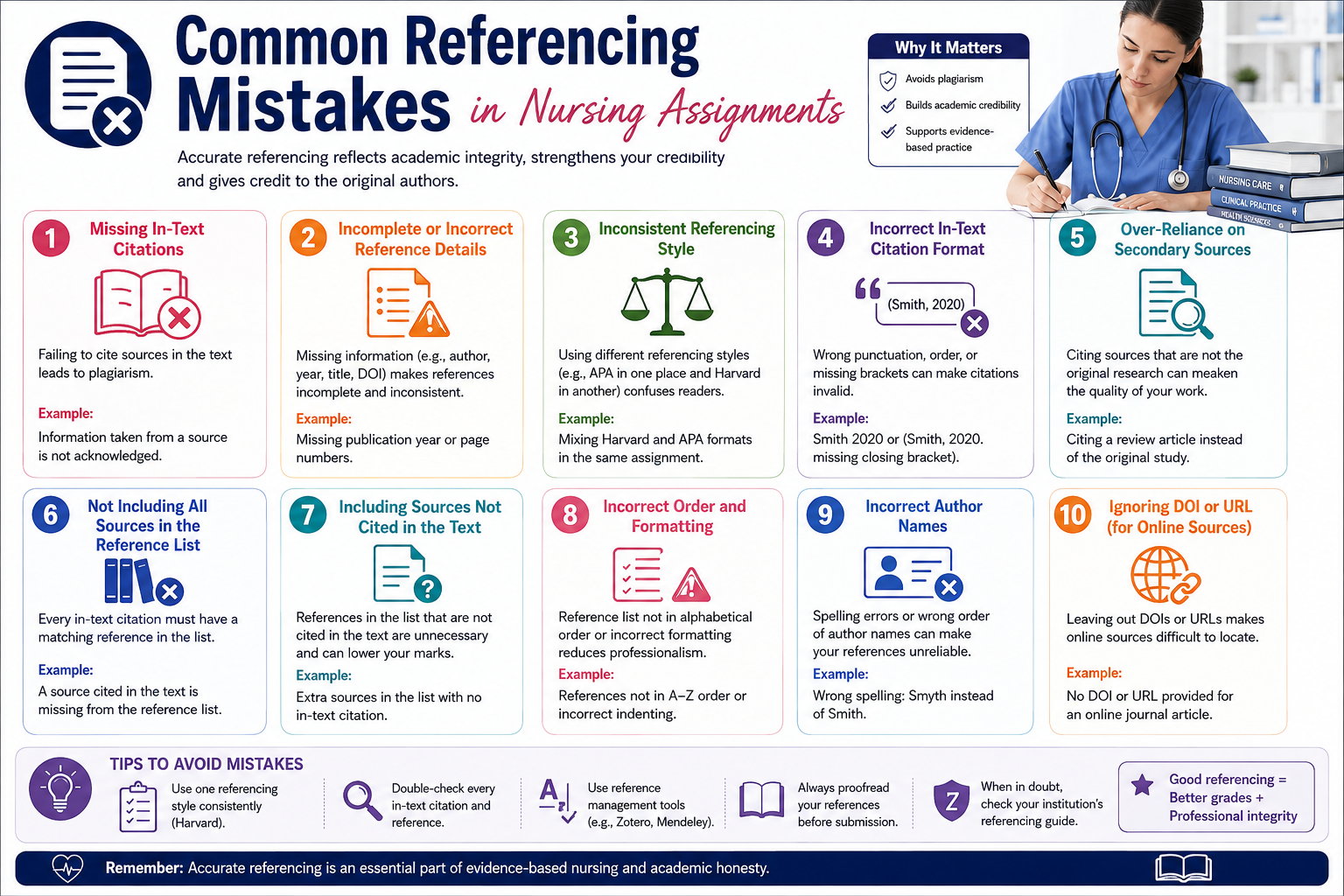
Referencing mistakes are one of the most consistent sources of lost marks across nursing programs, and they cut deeper than a typical academic essay because nursing referencing carries a second function: it's the audit trail behind every clinical claim you make. A wrong dosage figure or an unverifiable guideline recommendation isn't just a citation slip — it's a credibility problem. This guide covers the referencing mistakes that show up most often in nursing assignments, regardless of whether your institution requires APA, Harvard, or another author-date system, and exactly how to avoid each one.
Most of these mistakes aren't the result of not knowing the rules — they're the result of treating referencing as a final step tacked onto a finished draft rather than something woven into the research and writing process from the start. That distinction matters, because the fix for nearly every mistake below is the same underlying habit: build referencing into how you research and write, rather than trying to reconstruct it after the fact.
1. Using Unreliable or Non-Peer-Reviewed Sources
This is a content mistake before it's a formatting one, but it shows up in the reference list. Wikipedia, unverified health blogs, patient forums, and general-audience websites should never appear in a nursing reference list. These sources aren't peer-reviewed, their accuracy isn't independently verified, and citing them signals weak research skills even when the surrounding content is well-written.
Fix: Use CINAHL and PubMed as primary databases for nursing literature, and prioritize systematic reviews, randomized controlled trials, and clinical guidelines from recognized bodies such as NICE or WHO. If you're unsure whether a source is credible, check whether it's been peer-reviewed and whether the publishing body has clinical or academic authority on the topic — a hospital's official patient information page is a different tier of source than an anonymous health blog covering the same condition.
It's worth applying this check even to sources that look professional at first glance. Well-designed websites and confident-sounding health content don't automatically indicate peer review or clinical authority — always verify the publishing body itself, not just the presentation of the content, before deciding a source is credible enough to cite.
2. Citing Outdated Clinical Guidance
Clinical guidelines change, sometimes significantly, as new evidence emerges. A common mistake is citing a source that was accurate when published but has since been superseded by updated guidance — using a ten-year-old dosage recommendation, for instance, when the relevant guideline body has revised it since.
Fix: For clinical guidance specifically, aim for sources published within the last 5 to 7 years, and always check whether a cited guideline has a more recent edition before submitting. Foundational theories and models — such as Gibbs' Reflective Cycle or Maslow's Hierarchy — are an exception, since the original source remains the correct citation regardless of age.
3. Mismatched In-Text Citations and Reference List Entries
Every source cited in the body of the assignment needs a matching entry in the reference list, and every reference list entry needs to be cited somewhere in the text. This sounds obvious, but it's one of the most frequent errors markers flag, usually because it happens accidentally during editing — a source gets cut from the text but not the reference list, or added to the text late in the drafting process and never makes it into the final reference list.
Fix: Before submitting, go through the assignment specifically checking this alignment — not as part of a general proofread, but as its own dedicated pass. Read through your in-text citations one at a time and confirm each has a matching reference list entry, then check the reverse.
4. Leaving Referencing Until the End
Many referencing errors trace back to a single root cause: trying to reconstruct citations after the essay is already written, rather than citing as you go. By the time a draft is finished, it's easy to lose track of exactly which source supported which specific claim, especially across a 2500-word assignment drawing on 15 or more sources.
Fix: Cite the moment you use a source, even in a rough early draft. Keep a running log while researching — author, year, title, key finding, and why it's relevant — so the information needed for a correct citation is already on hand rather than something you're hunting for the night before the deadline.
This matters more than it might seem, because reconstructing citations after the fact doesn't just risk missing a reference — it risks misattributing a claim to the wrong source entirely, especially when several sources cover overlapping ground. Getting a clinical fact right but crediting it to the wrong source is still a referencing error, and one that's much harder to catch during a final proofread than a genuinely missing citation.
5. Inconsistent Referencing Style
Mixing citation conventions within a single assignment — using APA formatting in some places and Harvard in others — is common among students who've encountered both styles across different modules. Telltale signs include inconsistent punctuation between author and year, inconsistent use of quotation marks around article titles, or inconsistent italicization of journal and book titles.
Fix: Confirm which style your specific assignment requires before you start building your reference list, and check your reference entries against your institution's actual style guide rather than general memory of "author-date" conventions picked up from other coursework. If you regularly switch between styles across modules, keep a short reference sheet noting exactly where the two diverge, so you're not relying on memory alone under deadline pressure.
6. Overusing Direct Quotations
Nursing academic writing expects synthesis and paraphrasing, not transcription. A common mistake, especially among students still adjusting to academic writing conventions, is stringing together direct quotes rather than expressing the source's findings in the student's own words.
Excessive quoting signals that you haven't fully processed the material — you've located the information but not yet turned it into your own reasoning. It also disrupts the flow of an essay that should be built around your own analytical voice.
Fix: Paraphrase almost everything. Reserve direct quotes for the rare cases where exact wording carries specific technical, legal, or clinical significance that would be lost through paraphrasing, and keep any quote used short.
7. Close Paraphrasing That Isn't Real Paraphrasing
A subtler version of the quoting problem: rewording a source just enough to remove the quotation marks, while keeping the original sentence structure and most of the original phrasing intact. This is still treated as a form of plagiarism by most academic integrity policies, even with a citation present, because the citation attributes the idea but doesn't excuse copying the structure and wording.
Fix: After paraphrasing a source, read your version back without looking at the original. If it still closely tracks the original sentence's structure and word choices, rewrite it more substantially — restructure the sentence, change the order of ideas, and express the point using genuinely different phrasing.
A useful test: try explaining the source's finding out loud, as if summarizing it for a colleague who hasn't read it, before writing the paraphrase down. Writing from that spoken-explanation version tends to produce genuinely reworded text, because you're working from your own understanding of the idea rather than the original sentence sitting in front of you.
8. Secondary Referencing Without Flagging It
Secondary referencing means citing a source you only encountered quoted or summarized inside another source, rather than reading the original yourself. It's tempting when the original is hard to access, but it carries a real risk: you might be repeating someone else's misreading of the original material without knowing it.
Fix: Track down and read the original source wherever possible. If it's genuinely unavailable and secondary referencing is unavoidable, most referencing styles require this to be explicitly flagged in-text — for example, (Smith 2019, as cited in Jones 2023) — with only the source you actually read appearing in your reference list.
9. Citing a Source You Haven't Actually Read Properly
Related to secondary referencing but distinct: citing a source based only on its abstract, its title, or how another paper summarized it, without reading the source in enough depth to accurately represent what it actually says. This risks misattributing findings or oversimplifying nuanced results into a claim the original source doesn't fully support.
Fix: If you're citing a source to support a specific claim, make sure you've read enough of it to be confident that claim is accurately represented. If time doesn't allow for that with a particular source, it's safer to leave it out than to risk misrepresenting it.
This mistake is easy to fall into under time pressure, since an abstract often gives a fast, confident-sounding summary of a study's conclusions. But abstracts routinely simplify findings, omit important caveats about study limitations, or overstate results relative to the full paper — citing based on the abstract alone risks passing those simplifications straight into your assignment as if they were the complete picture.
10. Formatting Errors in the Reference List
Formatting mistakes are common and usually minor individually, but they add up across a full reference list and signal carelessness to a marker even when the underlying research is strong. Common examples include inconsistent capitalization (mixing sentence case and title case for article and journal titles), missing DOIs or URLs for online sources, incorrect italicization of journal or book titles, and reference lists that aren't properly alphabetized by first author surname.
Fix: Run a dedicated formatting check on the reference list as its own step, separate from checking content accuracy. Go entry by entry against your required style guide rather than assuming consistency across sources you copied from different databases or citation generators, which often format inconsistently by default.
Formatting errors tend to cluster in specific spots: the boundary between article titles and journal titles (which gets which capitalization or punctuation treatment), the handling of organizational authors versus individual authors, and the treatment of sources with unusual features like no listed author or no publication date. Checking these specific trouble spots individually across your reference list, rather than reading the whole list once for a general impression, catches far more errors.
11. Relying Too Heavily on Citation Generators
Tools that automatically generate formatted references — whether built into a database, a word processor, or standalone software like Zotero or Mendeley — save significant time, but they're not always accurate. They frequently mishandle organizational authors, web sources without clear publication dates, and edge cases like sources with no named author.
Fix: Use citation generators as a starting point, not a final answer. Manually check every generated entry against your actual required style guide before finalizing your reference list, particularly for any source type that isn't a straightforward single-author journal article.
12. Too Few or Too Many References
Under-referencing suggests a lack of research depth; over-referencing, especially citing far more sources than you've genuinely engaged with, can suggest padding rather than substantive research. For a 2500-word nursing assignment, 12 to 20 well-integrated references is the typical expectation, though this varies by institution and assignment type.
Fix: Prioritize depth of engagement with each source over sheer reference count. A smaller number of sources you've read thoroughly and integrated meaningfully into your argument produces a stronger assignment than a long reference list built from sources skimmed only briefly.
If you're unsure whether your reference count is in a reasonable range, check your assignment brief or rubric first — some institutions specify a minimum or expected range directly. In the absence of specific guidance, treat the count as a rough sanity check rather than a target to hit exactly: a 2500-word assignment with only four references likely hasn't engaged with enough evidence, while one with forty references, each cited only once in passing, likely hasn't engaged deeply enough with any of them.
13. Not Checking Institution-Specific Variations
Even within a single referencing style like APA or Harvard, individual institutions sometimes apply their own minor variations — different rules for running heads, different terminology for the reference list ("References" versus "Bibliography" versus "Reference List"), or different requirements around accessed dates for web sources.
Fix: Always check your specific program's published style guide alongside general referencing conventions, and treat your institution's guide as the final authority whenever the two differ.
A Practical Pre-Submission Referencing Checklist
Referencing errors are far cheaper to catch before submission than after — once an assignment is marked, an error you could have fixed in five minutes has already cost you marks. Before submitting any nursing assignment, run through this list as a dedicated step, separate from your general proofread:
- Every in-text citation has a matching reference list entry, and vice versa.
- Every source is credible and appropriately current for the claim it supports.
- No paraphrase closely mirrors the original source's sentence structure or wording.
- Direct quotes are rare, short, and genuinely necessary.
- Any secondary referencing is explicitly flagged, not presented as a direct citation of the original.
- Formatting is consistent throughout — capitalization, italics, quotation marks, and punctuation match your required style guide.
- The reference list is properly alphabetized and uses the correct heading terminology for your institution.
- You've read every source cited well enough to accurately represent what it says.
Final Thoughts
Nearly every referencing mistake covered here traces back to the same underlying cause: treating referencing as a final formatting step rather than an integral part of researching and writing the assignment. Citing as you write, keeping a running source log, choosing credible and current sources from the start, and running a dedicated referencing check before submission eliminates the large majority of these errors before they ever reach a marker. Build that discipline once, and it stops being a source of last-minute stress on every assignment for the rest of your program.
These habits also transfer directly into clinical practice. Accurately attributing a claim to its source, distinguishing verified guidance from unverified information, and being able to trace a decision back to credible evidence are exactly the skills nursing referencing is training, dressed up in academic formatting rules. Treating referencing precision as a professional skill worth developing properly — rather than a box to check before submission — makes the discipline easier to sustain across an entire program, and it's a skill that keeps paying off well beyond the classroom.