
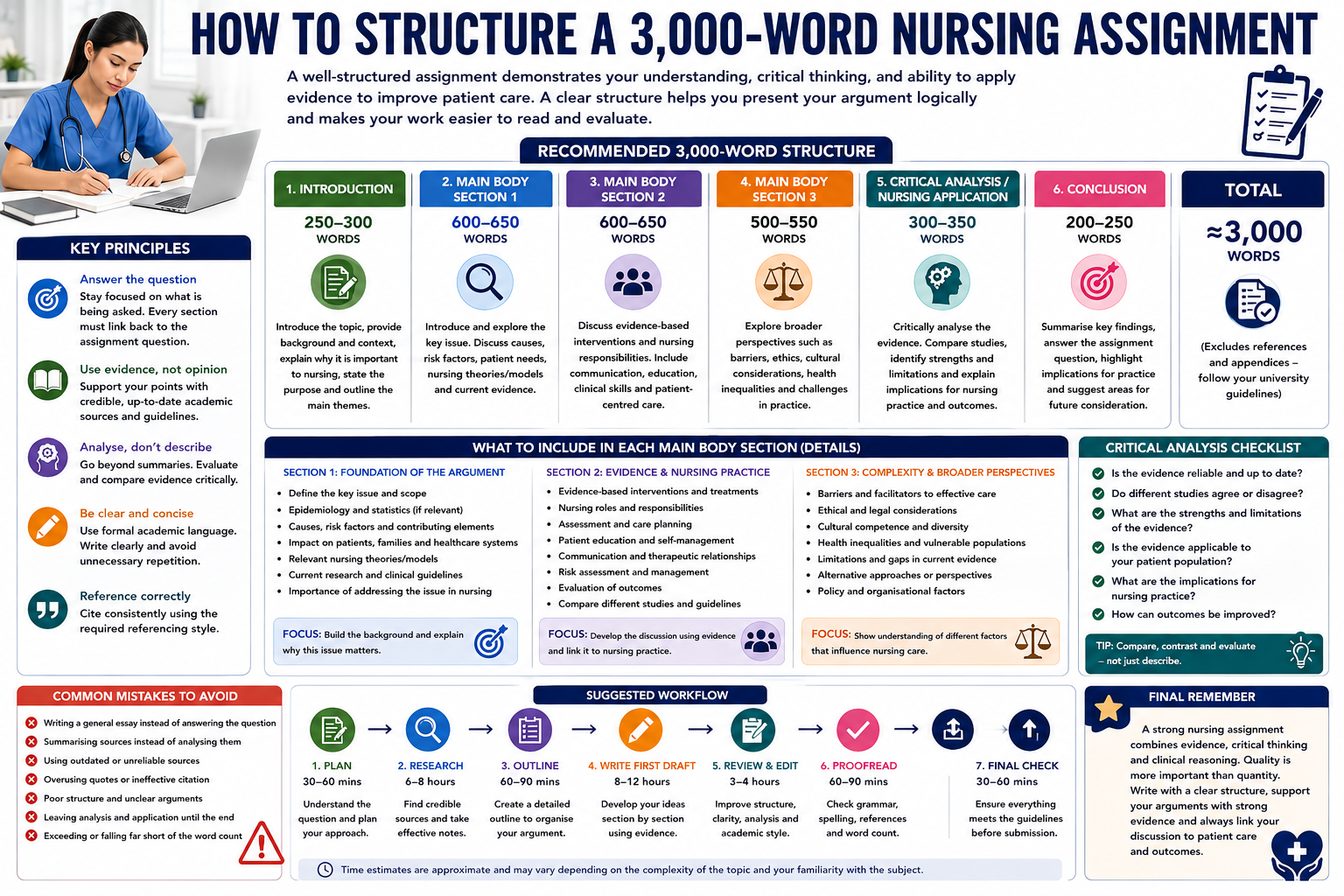
At 3,000 words, a nursing assignment stops behaving like an essay and starts behaving like a small research piece. You have enough space for a genuine literature review, multiple lines of counterargument, and sustained critical synthesis — but that space is also where assignments fall apart. Without a deliberate structure, 3,000 words either sprawls into a directionless survey of the topic or gets padded with repetition to hit the count.
This guide gives you the exact section breakdown, how to manage multiple sub-arguments without losing your central thread, and where the marks concentrate at this length — covering essay-style assignments, case studies, and full evidence-based practice (EBP) reports.
Why 3,000 Words Requires a Different Approach Entirely
At 1,000-2,000 words, you're building a single, tightly argued position. At 3,000 words, most nursing assignments expect something closer to a structured argument with multiple interacting parts — background, several strands of evidence, a sustained critical discussion, and specific application to practice. That's a genuinely different writing task, not just "the same essay, longer."
Three things change structurally at this length:
- You need explicit section headers or clearly signposted paragraphs, because the reader (your marker) can't hold an unstructured 3,000-word argument in their head the way they can a 1,000-word one.
- You have room for a real literature review or background section, not just a one-paragraph context-setter.
- You're expected to sustain critical analysis across multiple points, not just include one counterargument paragraph — shallow analysis repeated six times reads worse at 3,000 words than it does at 2,000, because there's more of it to notice.
The Word-Count Breakdown
Notice that a dedicated background/literature review section appears here for the first time in this series — at 1,000 and 2,000 words there usually isn't room for one as a separate section, but at 3,000 words, most rubrics expect it.
Step 1: Introduction (200–250 Words)
The introduction still follows the same core logic as shorter assignments, just with slightly more room to establish stakes:
- Context (2 sentences): The clinical issue, stated specifically.
- Significance (1–2 sentences): Why this issue matters — prevalence, patient safety implications, or a recognized gap in current practice.
- Aim/position (1–2 sentences): What the assignment sets out to argue, examine, or answer (for EBP assignments, this is where your PICO(T) question goes).
- Structure preview (2 sentences): A clear roadmap of the sections to follow — at this length, markers expect to know exactly where the assignment is going before they start reading the body.
Mistake to avoid: using the extra word count to write a general history of nursing or an overly broad opening ("Healthcare has changed dramatically over the past decade..."). Even at 3,000 words, the introduction should move to your specific focus within the first two or three sentences.
Step 2: Background or Literature Review (400–500 Words)
This section is where 3,000-word assignments diverge structurally from shorter ones. Its job is to establish what's already known before you move into critical discussion — not to argue yet, just to map the terrain.
What belongs here:
- Key statistics or prevalence data establishing the scale of the clinical issue.
- A brief overview of existing guidelines, policies, or standard practice.
- An honest note on where the evidence base is contested, incomplete, or evolving — this sets up your critical discussion section without duplicating it.
What doesn't belong here:
- Detailed critical appraisal of individual studies — save that for the body.
- Your own argument or position — this section should read as neutral scene-setting.
- Basic definitions of terms your target reader (a nursing marker) already knows.
A well-written background section makes the rest of the assignment easier to write, because it establishes shared context that you can refer back to ("as noted above, current guidelines recommend...") instead of re-explaining basics inside every body paragraph.
Step 3: Body — Critical Discussion (1,800–2,000 Words)
This is roughly two-thirds of the entire assignment, and it needs internal structure of its own. At 3,000 words, don't just write six paragraphs in a row — group them into two or three clearly labeled sub-sections, each containing two to three PEEL-structured paragraphs.
Suggested sub-section structure
Sub-section 1: Core evidence-based argument (700–800 words, 2–3 paragraphs) Your strongest position, built from your best sources. This is where you demonstrate command of the primary literature and establish the foundation the rest of the discussion builds on.
Sub-section 2: Counterargument, complications, or contested evidence (600–700 words, 2 paragraphs) At 3,000 words, one counterargument paragraph isn't enough — markers expect sustained engagement with tension in the evidence base. This might include conflicting study findings, populations where the evidence doesn't generalize, or practical/resource barriers that complicate implementation. Resolve the tension explicitly rather than just listing conflicting views side by side.
Sub-section 3: Broader factors — ethical, cultural, or interprofessional dimensions (400–500 words, 1–2 paragraphs) Many 3,000-word rubrics specifically look for engagement beyond pure clinical evidence — patient autonomy, cultural safety, resource allocation, or interprofessional collaboration. Check your brief, but if this dimension is expected and you skip it, you'll likely lose marks regardless of how strong your clinical argument is.
Synthesis is the difference-maker at this length
By 3,000 words, simply summarizing sources — even accurately — reads as underdeveloped. Markers expect you to actively synthesize: show where multiple sources converge, where they conflict, and what that conflict means for practice, rather than treating each source as a separate mini-summary.
Underdeveloped (source-by-source): "Chen et al. (2023) examined fall prevention interventions and found positive results. Okafor and Lin (2022) also studied fall prevention and found similar benefits. However, Reyes (2024) found mixed results in a different population."
Developed (synthesized): "Fall prevention interventions show consistent short-term benefit across acute settings (Chen et al., 2023; Okafor & Lin, 2022), but Reyes' (2024) findings in community-dwelling older adults suggest the effect is highly dependent on caregiver involvement — a variable the acute-setting studies didn't control for, which limits how confidently these findings can be generalized to discharge planning."
Step 4: Application to Practice (300–400 Words)
At shorter word counts, application to practice is often folded into the final body paragraph. At 3,000 words, it earns its own dedicated section, because markers want to see explicit translation from evidence to action.
Structure this section around concrete, specific changes:
- What should change in assessment, intervention, or documentation?
- What are the resource or training implications of implementing this?
- Are there barriers to implementation worth acknowledging (time, staffing, patient factors)?
Avoid vague statements like "nurses should be aware of this issue." Specify what awareness translates into — a change in a specific assessment tool, a modified handover process, a targeted patient education approach.
Step 5: Conclusion (250–300 Words)
A 3,000-word conclusion needs to do more synthesis work than a shorter one, precisely because there's more content to pull together. Structure:
- Restate the position (2–3 sentences): Synthesized, not copy-pasted from the introduction.
- Summarize the key discussion points (3–4 sentences): Including how the counterargument or contested evidence was ultimately weighed.
- State the clinical/professional significance (2–3 sentences): Why this matters for nursing practice specifically.
- Specific recommendation or implication (1–2 sentences): Concrete, not a vague call for "further research" — if you recommend further research, specify what question it should answer and why.
No new evidence, no new citations, no new arguments — this rule doesn't change no matter how much extra room you have.
Referencing at 3,000 Words
Most 3,000-word nursing assignments expect a substantially wider evidence base than shorter pieces — commonly in the range of 20-30 sources, though this varies significantly by institution and assignment type. Practical guidance:
- Prioritize systematic reviews, meta-analyses, and primary research over textbooks and general websites.
- Favor sources from the last 5-7 years, with foundational nursing theories or landmark studies as the main exception.
- At this length, having sources that only appear once and add nothing to the synthesis is a common and easily fixed weakness — every citation should be doing active work, not just padding the reference list.
- Confirm your required citation style (APA 7th, Harvard, Vancouver) and apply it with total consistency — inconsistent referencing becomes more visible, and more heavily penalized, the longer the reference list gets.
Common Structural Mistakes at This Word Count
1. Writing six or seven separate points with no grouping. Without sub-sections, a 3,000-word body reads as an unstructured list. Group your paragraphs into two or three clearly labeled or signposted sub-sections so the marker can follow the argument's shape.
2. Treating the background section as a second introduction. The background section should map existing knowledge, not restate your argument. If it starts sounding like your introduction, you're duplicating content instead of building on it.
3. Under-using the extra space for counterargument. A single counterargument paragraph, copy-pasted from what would work at 2,000 words, is noticeably thin at 3,000. Markers expect sustained engagement with complexity, not a token acknowledgment.
4. Skipping the dedicated application-to-practice section. At this length, folding practice implications into your last body paragraph reads as an afterthought. Give it its own clearly marked space.
5. Losing the central thread across multiple sub-sections. With more moving parts, it's easy for a 3,000-word assignment to drift from its original aim. Periodically re-read your introduction's stated aim while drafting the body to check you're still answering it.
6. Reference padding. Adding sources purely to hit a target reference count, without integrating them meaningfully into the synthesis, is easy for markers to spot and actively weakens the flow of your argument.
A Worked Example: Structuring a 3,000-Word EBP Report
- Introduction (220 words): Clinical problem, significance, PICO(T) question, structure preview.
- Background (450 words): Prevalence/context, current guidelines, note on where evidence is contested.
- Search strategy (150 words): Databases, keywords, inclusion/exclusion criteria — brief, not a full methods chapter.
- Critical appraisal, evidence strand 1 (600 words): Two to three studies supporting the core position, individually appraised (e.g., using CASP), then synthesized.
- Critical appraisal, evidence strand 2 (600 words): Contradicting or complicating evidence, appraised and synthesized against strand 1.
- Broader considerations (450 words): Ethical, cultural, or interprofessional dimensions relevant to implementation.
- Application to practice (350 words): Specific, concrete recommendations for clinical practice.
- Conclusion (280 words): Synthesis, significance, specific recommendation.
This adds up to roughly 3,100 words before trimming — a realistic first-draft target, since most students cut 5-10% during editing rather than writing exactly to the limit on the first pass.
A Quick Pre-Submission Checklist
- Does your assignment have a distinct, clearly signposted background/context section, separate from both the introduction and the critical discussion?
- Is your body organized into two to three clear sub-sections rather than a flat list of paragraphs?
- Is there sustained counterargument or engagement with contested evidence — not just one token paragraph?
- Does application to practice get its own dedicated section with specific, concrete recommendations?
- Are you synthesizing across sources within and between sub-sections, not just summarizing them individually?
- Is your reference list wide enough (typically 20-30 sources) and is every citation earning its place?
- Does your conclusion synthesize rather than repeat the introduction, and avoid introducing new content?
The Bottom Line
A 3,000-word nursing assignment needs real architecture — a background section to establish context, a body organized into clearly signposted sub-sections, sustained counterargument rather than a single token paragraph, and a dedicated section translating evidence into practice. The temptation at this length is to let the extra space turn into either sprawl or repetition; the fix is the same one that works at every word count in this series — plan your section-by-section allocation before you start writing, and spend the extra room on depth, synthesis, and structure rather than on more surface-level points. Get the architecture right first, and a 3,000-word assignment stops feeling unmanageable and starts feeling like exactly what it is: four or five well-built 600-word sections stitched into one coherent argument.