
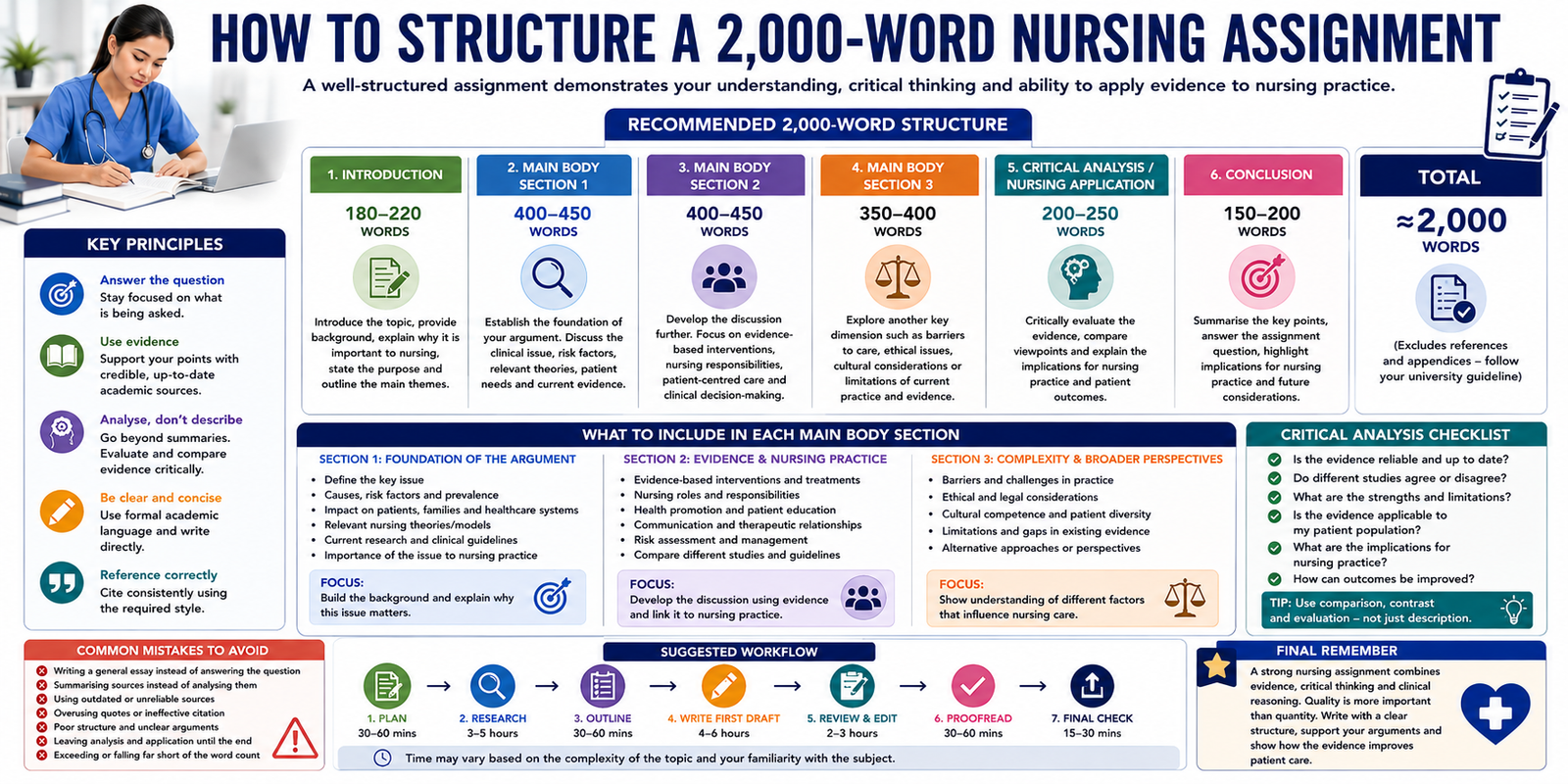
A 2,000-word nursing assignment sits in an awkward middle ground. It's long enough that you can't get away with the tight, single-argument structure of a 1,000-word piece, but it's short enough that padding will get noticed immediately. Most students either treat it like a mini-essay and end up underdeveloped, or treat it like a dissertation chapter and run out of words before finishing their argument.
This guide gives you an exact section-by-section word allocation, how to structure multi-point arguments without losing coherence, and where nursing markers actually award the marks in a 2,000-word piece — whether it's an evidence-based practice essay, a case study, or a critical analysis assignment.
Why 2,000 Words Changes the Structural Rules
At 1,000 words, you're forced into two or three points with minimal room for nuance. At 2,000 words, you have space for four to five points, genuine counterargument, and deeper engagement with evidence — but that extra space is exactly where assignments go wrong. Students either:
- Add more points instead of more depth, ending up with six shallow paragraphs instead of four well-developed ones.
- Repeat the same point in different words to fill space, which markers spot instantly.
- Let the introduction and conclusion expand to match the extra length, when they should stay roughly proportional.
The extra 1,000 words compared to a shorter assignment should go almost entirely into deeper analysis and stronger evidence — not more topics and not more throat-clearing.
The Word-Count Breakdown
The proportions barely shift from a 1,000-word assignment — the introduction and conclusion still sit around 10% each. What changes is what happens inside the body: more points, more evidence per point, and — critically — a dedicated space for counterargument or limitations, which a 1,000-word piece often can't afford.
Step 1: Introduction (150–200 Words)
A 2,000-word introduction needs slightly more scaffolding than a short assignment, but it should still avoid background-dumping. Structure it in four moves:
- Context (1–2 sentences): The clinical area or scenario, stated specifically, not generically.
- Problem or gap (1–2 sentences): Why this topic matters — a clinical challenge, a practice gap, or a tension in the evidence base.
- Position or aim (1 sentence): What your assignment will argue or examine.
- Structure preview (1–2 sentences): The order your main points will follow.
Common mistake: using the extra word allowance to define basic terms ("Nursing is a profession that..."). At this word count, markers expect you to move straight into the clinical substance — save definitions for genuinely contested or technical terms only, and even then, define them in one clause, not a paragraph.
Step 2: Body Paragraphs (1,500–1,600 Words)
This is where a 2,000-word assignment earns its length. Aim for four to five main points, each roughly 300-350 words, structured with the PEEL method:
- Point — the specific claim, stated in one sentence.
- Evidence — a citation from peer-reviewed literature, clinical guidelines, or an established nursing framework.
- Explain — the step that separates a pass from a distinction: what does this evidence actually mean for practice, patient outcomes, or clinical decision-making?
- Link — connect back to your overall argument and forward to the next point.
Suggested body structure for a 2,000-word assignment
Paragraphs 1–2 (600–700 words): Core clinical argument. Establish the main evidence-based position, using your strongest sources first. This is where you demonstrate command of the core literature.
Paragraph 3 (300–350 words): Counterargument or complicating evidence. This is the paragraph 1,000-word assignments usually can't fit, and it's disproportionately valuable. Present evidence that complicates or challenges your main position — conflicting study findings, a population where the evidence doesn't hold, or a practical barrier to implementation. Nursing markers consistently reward this because it demonstrates critical thinking rather than one-sided argument-building.
Paragraph 4 (300–350 words): Application to practice. Translate the theoretical or research-based discussion into concrete clinical implications — how does this change assessment, intervention, documentation, or patient education in real practice?
Paragraph 5 (optional, 300 words): Wider implications. Policy, interprofessional practice, or patient safety implications, if relevant to your specific brief. Not every 2,000-word assignment needs this fifth paragraph — check your rubric before adding a point just to hit the word count.
The difference between "more words" and "more depth"
At 1,000 words, one citation per point is often sufficient. At 2,000 words, markers expect you to triangulate — bring in two or three sources per major point, note where they agree or disagree, and draw a synthesized conclusion rather than reporting each source in isolation. This is the single biggest structural upgrade between a 1,000-word and a 2,000-word nursing assignment: synthesis instead of sequential summary.
Weak version (sequential summary): "Smith (2023) found that X. Jones (2022) found that Y. Patel (2024) also studied this area."
Strong version (synthesis): "While Smith (2023) and Patel (2024) both report improved adherence following structured education, Jones (2022) found this effect diminished significantly without follow-up reinforcement — suggesting the intervention's timing matters as much as its content."
Step 3: Conclusion (200 Words)
The conclusion of a 2,000-word assignment has slightly more room than a short piece, but the rule stays the same: no new evidence, no new arguments. Use the extra space for a stronger synthesis, not new content.
Effective structure:
- One to two sentences restating your overall position, synthesized rather than copy-pasted from the introduction.
- Two to three sentences pulling together your strongest points, including how the counterargument paragraph was resolved or accounted for.
- One to two sentences on the clinical or professional significance — why this matters for nursing practice, patient safety, or future care.
- Optionally, one sentence on a specific, realistic recommendation (not a vague call for "more research").
Using Subheadings in a 2,000-Word Assignment
Whether you use subheadings depends entirely on your program's requirements — some explicitly forbid them in essay-style assignments, others expect them for case studies and EBP reports. Check your brief before deciding.
If subheadings are permitted or expected, a common structure looks like:
- Introduction
- Background/Context
- [Main argument section 1]
- [Main argument section 2]
- Critical discussion / Limitations
- Application to practice
- Conclusion
If subheadings are not permitted, use strong topic sentences at the start of each paragraph instead — they should do the same organizational work as a subheading would, signaling exactly what that paragraph covers.
Referencing at 2,000 Words
A 2,000-word nursing assignment typically expects a noticeably wider evidence base than a 1,000-word one — most rubrics look for somewhere in the range of 12-20 sources, depending on the assignment type, compared to 6-10 for a shorter piece. A few practical rules:
- Prioritize primary research and systematic reviews over textbooks, and prioritize the last 5-7 years unless citing a foundational theory or landmark study.
- Don't cite a source just to hit a number — an unused or barely-relevant citation is easy for a marker to spot and actively hurts the flow of your argument.
- Keep your citation style consistent (APA 7th, Harvard, Vancouver, or whatever your program requires) — mixed styles are one of the most common and most easily avoidable point deductions.
- Check whether in-text citations and the reference list count toward your word limit — this varies by institution and matters more at this length, since 12-20 references add up.
Common Structural Mistakes at This Word Count
1. Adding points instead of depth. Six underdeveloped 250-word paragraphs will consistently score lower than four fully developed 400-word paragraphs. If you're not sure whether to add a new point or deepen an existing one, deepen the existing one.
2. Skipping the counterargument paragraph. This is the section most likely to be cut when students run out of words, and it's also the section markers weight most heavily for critical thinking marks. Protect this paragraph before you protect anything else in the body.
3. Sequential summary instead of synthesis. Listing what each source says, one after another, without comparing or synthesizing them, reads as descriptive rather than analytical — the same issue that caps shorter assignments at a pass grade, just more visible at 2,000 words because there's more room for it to repeat.
4. Letting the introduction or conclusion balloon. At this length, it's tempting to let the introduction stretch to 300+ words because there's "more room." Resist it — the proportional structure (roughly 10% each) still holds regardless of total length.
5. Inconsistent depth across body paragraphs. A common pattern: the first two paragraphs are strong and well-evidenced, and the assignment visibly thins out by paragraph four as the student runs low on time or words. Plan your word allocation per paragraph before writing so this doesn't happen — see the breakdown above.
6. Treating a 2,000-word assignment as "two 1,000-word assignments stapled together." Each section needs to connect to a single overarching argument. If you could rearrange your body paragraphs in any order without it mattering, they aren't properly linked — go back and add explicit transitions that reference the previous point.
A Worked Example: Structuring a 2,000-Word Evidence-Based Practice (EBP) Essay
EBP assignments follow a recognizable pattern that maps well onto the word-count breakdown above:
- Introduction (180 words): Clinical problem, PICO(T) question, and aim of the essay.
- Background (250 words): Brief context on why this clinical issue matters and its prevalence or significance.
- Search strategy and evidence overview (200 words): Briefly outline how evidence was identified — databases, keywords, inclusion criteria — without turning this into a full methods section.
- Critical appraisal of evidence 1 (350 words): Strongest study or systematic review, appraised using a tool like CASP — strengths, limitations, relevance.
- Critical appraisal of evidence 2 (350 words): A second study, ideally one that complicates or adds nuance to the first.
- Synthesis and critical discussion (350 words): Where the two (or more) sources agree, disagree, and what that means for practice — this is the highest-value section in the entire assignment.
- Application to practice (200 words): Concrete recommendations for clinical practice, patient care, or policy.
- Conclusion (200 words): Summary and significance, not new content.
Notice that the "critical appraisal" and "synthesis" sections together take up nearly half the total word count. That's deliberate — in EBP assignments specifically, appraisal and synthesis are where the vast majority of marks sit, not in background or context.
A Quick Pre-Submission Checklist
- Does your introduction sit at roughly 150-200 words, not longer?
- Do you have four to five body points, each fully developed with evidence, explanation, and a link — not six or seven shallow ones?
- Is there a dedicated paragraph addressing counterargument, limitations, or complicating evidence?
- Are you synthesizing sources against each other, not just summarizing them one after another?
- Does your conclusion avoid introducing new evidence or arguments?
- Have you checked your program's specific rules on subheadings, word-count inclusions, and reference count?
- Is your evidence base wide enough for 2,000 words (typically 12-20 sources), and is every citation actually earning its place?
The Bottom Line
A 2,000-word nursing assignment isn't just a longer 1,000-word one — the extra length is supposed to buy you room for synthesis, counterargument, and deeper application to practice, not more surface-level points. Keep your introduction and conclusion proportional at around 10% each, dedicate 75-80% of your word count to four or five well-developed body points, and protect the counterargument paragraph even when you're tight on words — it's disproportionately valuable for the marks it earns. Plan the word allocation before you start writing, and the difference between a pass and a strong grade usually comes down to synthesis over summary, not extra clinical knowledge you don't already have.