
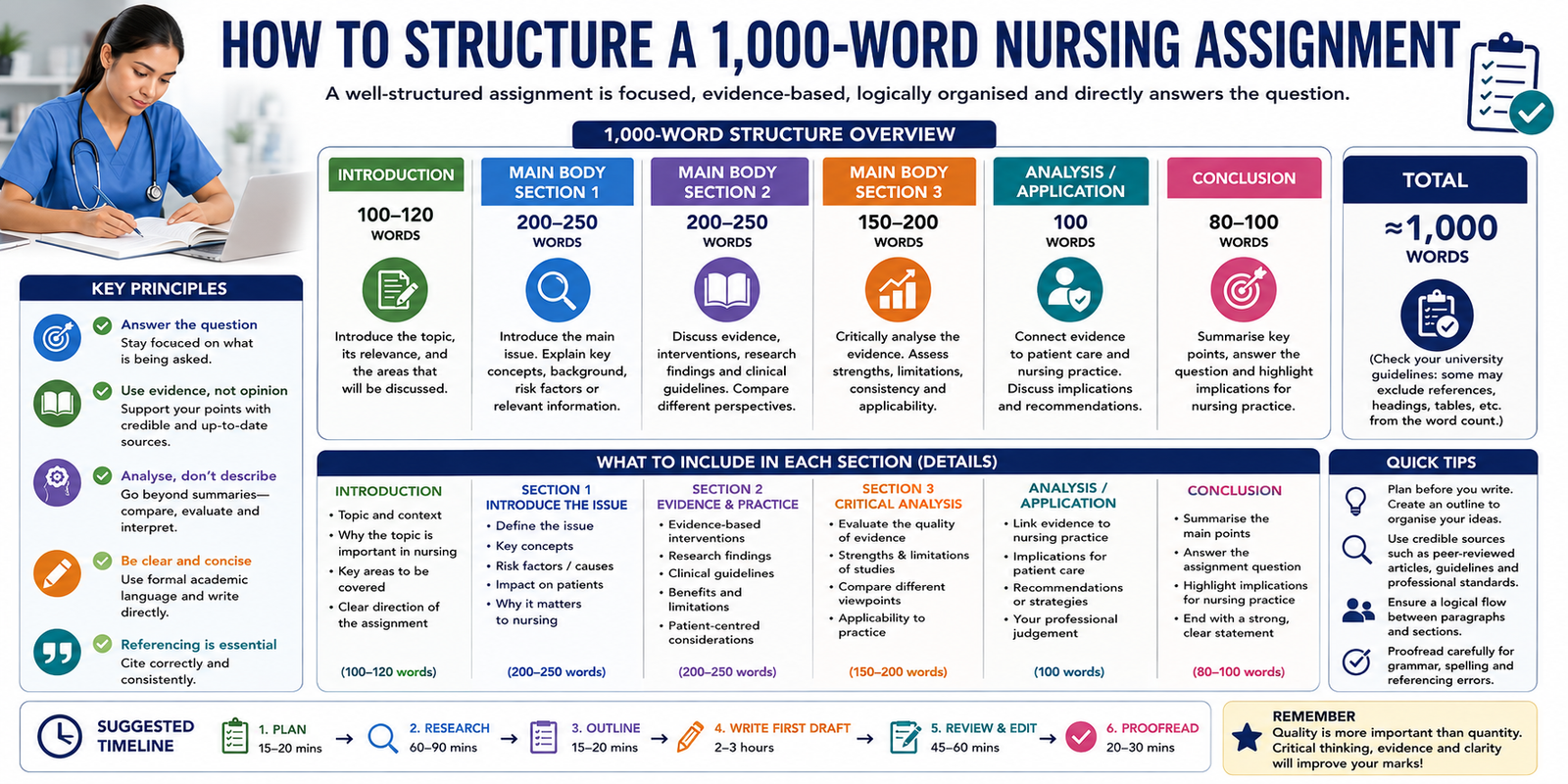
A thousand words sounds generous until you try to fit an introduction, evidence-based content, critical analysis, and a conclusion into it without the whole thing reading like a rushed summary. Most nursing students lose marks on 1,000-word assignments not because the clinical knowledge is wrong, but because the structure is wasteful — too much throat-clearing in the introduction, not enough analysis in the body, or a conclusion that just repeats the introduction word for word.
This guide gives you an exact word-count breakdown, section-by-section instructions, and the mistakes that quietly cost the most marks in short nursing assignments — whether it's a reflective essay, a case study, or an evidence-based practice piece.
Why 1,000-Word Nursing Assignments Are Harder Than They Look
Short assignments are unforgiving. In a 3,000-word essay, you have room to explore a concept, circle back, and develop an argument gradually. In 1,000 words, every sentence has to earn its place. Markers grading short nursing assignments are specifically looking for precision: can you identify the most clinically relevant points, support them with evidence, and discard everything else?
This is why a clear structure matters more here than in longer assignments. Without one, you'll either run out of words before making your argument, or you'll pad the introduction and conclusion so heavily that there's nothing left for actual analysis.
The Word-Count Breakdown
Before writing a single sentence, allocate your word count. This is the single most effective habit for keeping a 1,000-word nursing assignment tight and well-balanced.
That 75% dedicated to the body is non-negotiable. If your introduction creeps past 150 words or your conclusion turns into a second discussion section, you're stealing space from the part of the assignment that's actually graded on depth: your analysis.
Step 1: Introduction (100 Words)
The introduction of a short nursing assignment has exactly three jobs: state the topic, state your position or focus, and preview the structure. Nothing else belongs here.
What to include:
- One sentence introducing the clinical topic or scenario.
- One sentence stating the specific angle or argument you're taking (not "this essay will discuss diabetes management" — instead, "this essay critically examines the role of patient education in type 2 diabetes self-management").
- One sentence signposting what the body will cover.
What to cut:
- Dictionary definitions of common terms ("Nursing is defined as...").
- Broad historical context unrelated to your specific focus.
- Restating the assignment brief in your own words at length.
A 100-word introduction has room for roughly 4-5 sentences. If you're writing more than that, you're taking space away from your analysis — go back and cut.
Step 2: Body Paragraphs (750 Words)
This is where nursing assignments are actually won or lost. With 750 words, aim for two to three main points, not five or six. Trying to cover too much ground in a short assignment is the single most common reason students end up with shallow, list-like paragraphs instead of real analysis.
The PEEL structure for each paragraph
Each body paragraph should follow a consistent, evidence-driven structure:
- Point — state the argument or clinical point in one sentence.
- Evidence — cite a peer-reviewed source, clinical guideline, or theoretical model that supports it.
- Explain — this is the step students skip, and it's the one markers reward most. Don't just drop a citation — explain what the evidence means for nursing practice.
- Link — connect the point back to your overall argument or to the next paragraph.
Example allocation for three body paragraphs (750 words):
- Paragraph 1 (250 words): Core clinical concept, supported by primary evidence.
- Paragraph 2 (250 words): A counterpoint, complication, or alternative perspective — this is what separates a pass from a strong grade, because it shows critical thinking rather than description.
- Paragraph 3 (250 words): Application to practice — how this translates into actual nursing care, patient safety, or clinical decision-making.
What markers are actually looking for in the body
Nursing rubrics almost universally reward critical analysis over description. A paragraph that says "Patients with poor health literacy struggle to manage chronic conditions" is descriptive. A paragraph that says "While health literacy interventions improve short-term adherence, evidence suggests the effect diminishes without reinforcement at follow-up, which has direct implications for discharge planning" is analytical — it evaluates, not just reports.
If you're not sure whether a sentence is descriptive or analytical, ask: does this sentence just state a fact, or does it evaluate, compare, question, or apply that fact? If it's the former, either cut it or add analysis after it.
Step 3: Conclusion (100 Words)
The conclusion is not a second discussion section. Its only job is to summarize your key points and close the argument — no new evidence, no new citations, no new ideas.
Effective 100-word conclusion structure:
- One sentence restating the overall position (in different words than the introduction).
- One to two sentences summarizing the strongest points from the body.
- One sentence on the broader clinical or professional implication — why this matters for nursing practice.
Avoid ending with a vague, unsupported statement like "further research is needed" unless you can specify what kind of research and why — vague hedging in a conclusion reads as filler, and markers notice.
Formatting and Referencing (Doesn't Count Toward Word Limit)
Most nursing programs exclude the reference list from the word count, but formatting still matters for marks:
- Use the exact citation style specified in your brief — APA 7th, Harvard, or Vancouver are the most common, and they are not interchangeable.
- Prioritize sources published in the last 5-7 years unless you're citing a foundational nursing theory (Orem, Roy, Watson) or a landmark study.
- Use primary research and systematic reviews over textbooks or websites wherever possible — nursing markers weight peer-reviewed evidence heavily.
- Double-check whether in-text citations, headings, and the reference list itself count toward your word limit — this varies by institution, and getting it wrong either wastes words or gets you penalized for going over.
Common Structural Mistakes in Short Nursing Assignments
1. Front-loading the introduction with background instead of analysis. If your introduction takes 250 of your 1,000 words, you've already lost a quarter of your assignment to a section that's worth the least marks.
2. Trying to cover too many points. Two well-developed points with strong evidence and analysis will always outscore five underdeveloped ones. Depth beats breadth in short assignments.
3. Description instead of critical analysis. Summarizing what a source says without evaluating it, applying it, or comparing it to another source is the most common reason students plateau at a pass grade instead of reaching a merit or distinction.
4. No clear link between paragraphs. Each paragraph should connect logically to the next. If a marker can't tell why paragraph 2 follows paragraph 1, your argument reads as disjointed even if each individual paragraph is well-written.
5. A conclusion that just repeats the introduction. Copy-pasting your introduction's phrasing into the conclusion (with minor word swaps) signals that you ran out of ideas rather than that you built an argument.
6. Ignoring the specific assignment brief in favor of a generic structure. This guide gives you a strong default structure, but always check your specific rubric first — some nursing programs require a fixed structure (e.g., mandatory subheadings, a specific reflective model, or a required number of sources) that overrides general best practice.
A Worked Example: Structuring a 1,000-Word Reflective Essay
Reflective essays are one of the most common short nursing assignments, and they follow a slightly different logic than an argumentative essay. Using Gibbs' Reflective Cycle as an example:
- Introduction (100 words): Briefly introduce the clinical situation you're reflecting on and the reflective model you're using.
- Description (150 words): What happened — factual, not evaluative yet.
- Feelings (100 words): Your emotional response at the time, described honestly and professionally.
- Evaluation (150 words): What went well and what didn't, briefly.
- Analysis (250 words): The most important section — connect your experience to theory, evidence, or nursing standards. This is where most of your marks come from.
- Conclusion and action plan (150 words): What you learned and what you'd do differently, tied to a specific, realistic action.
Notice that even within a reflective structure, the "analysis" section gets the largest word allocation — the same principle as an argumentative essay's body paragraphs. Reflection without analysis is just storytelling, and nursing markers are trained to spot the difference.
A Quick Pre-Submission Checklist
Before you submit, run through this:
- Does your introduction take up roughly 10% of the word count, not more?
- Does each body paragraph include evidence AND explanation, not just evidence?
- Have you cut any purely descriptive sentences that don't add analysis?
- Does your conclusion avoid introducing new information?
- Is your citation style consistent throughout, not mixed?
- Have you checked whether headings and references count toward your word limit?
- Does every paragraph explicitly connect back to the assignment question?
The Bottom Line
A 1,000-word nursing assignment isn't a shorter version of a 3,000-word one — it's a different writing exercise entirely. The word-count pressure forces you to prioritize ruthlessly: fewer points, made more sharply, backed by stronger evidence and real analysis instead of description. Allocate roughly 10% to your introduction, 75% to two or three well-developed body points, and 10% to a conclusion that closes rather than repeats your argument. Get that structure right before you start writing the content, and the actual writing becomes far easier — you're filling a framework instead of guessing how much space you have left as you go.