
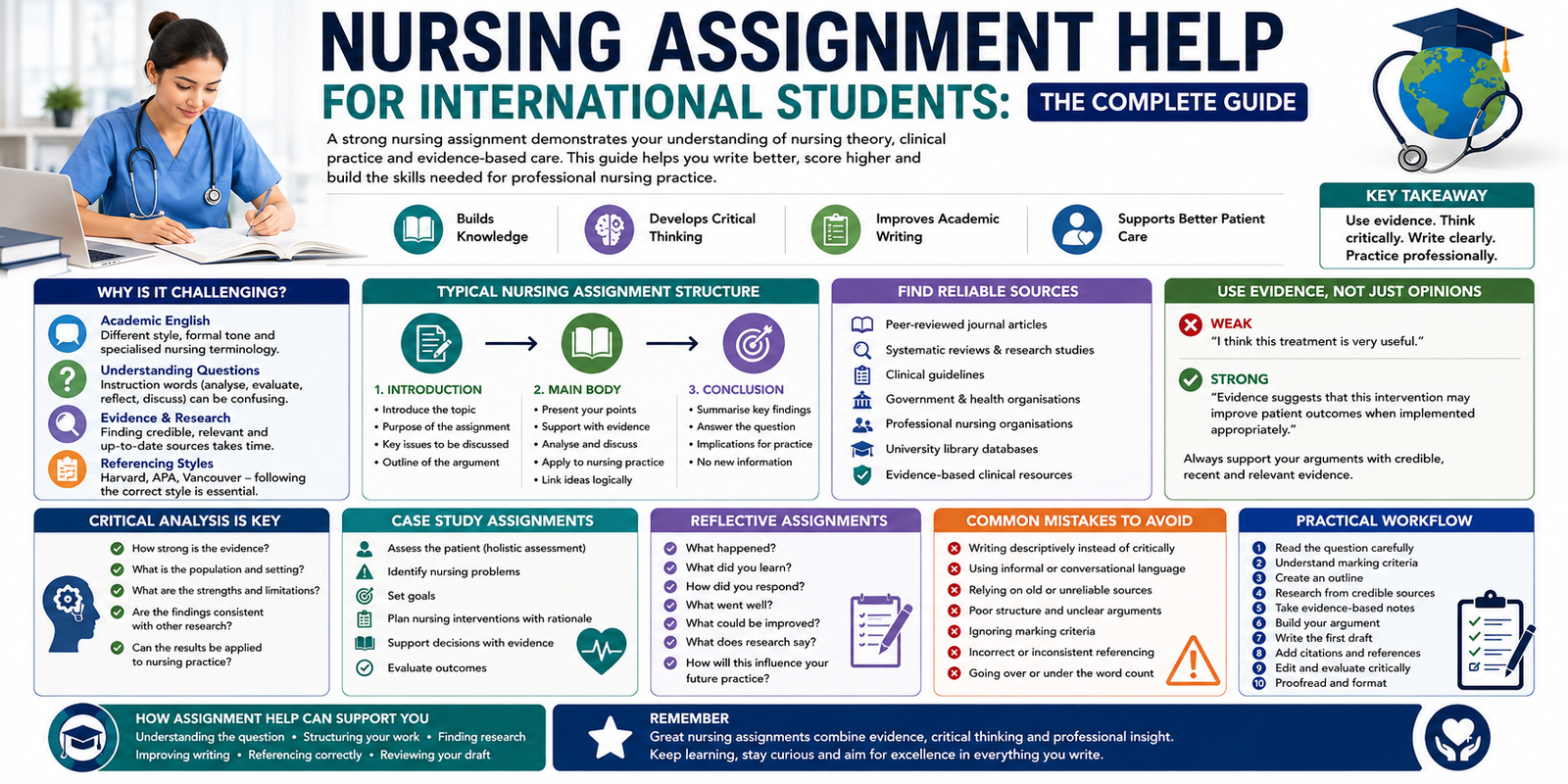
Nursing school is hard enough when English is your first language and you grew up in the education system you're studying in. Add a language barrier, an unfamiliar academic culture, part-time work to cover living costs, and clinical placements that eat 20-30 hours a week, and "hard" becomes "borderline unmanageable." This is exactly why Nursing Assignment Help has become one of the most searched academic support terms among international nursing students in the UK, Australia, Canada, and the US.
This guide breaks down why international nursing students struggle, what kinds of assignments actually give them trouble, how to evaluate nursing assignment help services without getting scammed, and what you can do yourself to close the gap — because outsourcing everything isn't a strategy, it's a liability.
Why International Nursing Students Need Extra Support
Nursing isn't a subject you can cram. It combines clinical practice, evidence-based research, reflective writing, pharmacology, ethics, and communication skills — and every one of those areas has its own writing conventions. For a domestic student, this is already a heavy load. For an international student, three additional pressures stack on top of it.
1. Academic English is not conversational English. You might be fluent enough to hold a conversation with a patient, but academic nursing writing demands formal register, precise terminology, and strict citation rules (APA 7th edition, Harvard, or Vancouver depending on your institution). Reflective essays require you to write in first person while still sounding academic — a style most international students have never been taught.
2. Clinical placement hours leave almost no time for assignments. Nursing degrees are not desk-based. Between 37.5-hour clinical weeks, night shifts, and travel time to placement sites, many international students are writing 2,000-word case studies at 11pm after a 12-hour shift. This is the single biggest reason students search for nursing assignment help — not because they can't do the work, but because there literally aren't enough hours in the week.
3. Unfamiliar assessment formats. Care plans, SOAP notes, Gibbs' Reflective Cycle essays, concept maps, and evidence-based practice (EBP) reports are graded on rigid rubrics that vary by university. A student trained in a different country's nursing curriculum has to learn an entirely new assessment language on top of the clinical content itself.
What Does "Nursing Assignment Help" Actually Mean?
The term covers a broad range of academic support services, and it's worth being precise about what falls under it because not all of it is equal:
- Editing and proofreading — grammar, clarity, and academic tone correction without changing your ideas.
- Structural and referencing support — fixing citation formatting, reference lists, and paragraph structure to match rubric requirements.
- Concept explanation and tutoring — breaking down pathophysiology, pharmacology calculations, or nursing theory (e.g., Orem's Self-Care Deficit Theory, Roy's Adaptation Model) so you can write the assignment yourself.
- Sample assignments and model answers — example care plans or reflective essays used as a learning template, not for submission.
- Full assignment writing services — a third party writes the assignment for you.
That last category is the one you need to think carefully about. Most universities in Australia, the UK, and Canada now run every submission through Turnitin plus AI-detection software, and academic misconduct penalties for international students are severe — they can trigger visa consequences, not just a failed module. If you're going to search for nursing assignment help, understand which category you actually need before you pay for anything.
Common Nursing Assignments That International Students Struggle With
1. Reflective Practice Essays
These use models like Gibbs' Reflective Cycle, Kolb's Experiential Learning Cycle, or Driscoll's "What? So What? Now What?" framework. The difficulty isn't the clinical content — it's the writing style. Reflective essays require personal voice combined with academic evidence, which is a genuinely unusual combination for students trained in more formal, third-person academic traditions.
2. Care Plans and Nursing Process Documentation
Care plans follow the ADPIE framework (Assessment, Diagnosis, Planning, Implementation, Evaluation) and require precise clinical terminology plus correct NANDA-I nursing diagnosis phrasing. Small wording errors here aren't just style issues — they can misrepresent clinical reasoning and cost significant marks.
3. Evidence-Based Practice (EBP) Reports
These require critically appraising peer-reviewed research using frameworks like PICO(T) and appraisal tools such as CASP. International students often understand the clinical concept but struggle with critically evaluating study methodology in academic English, which is a distinct skill from reading comprehension.
4. Pharmacology and Dosage Calculations
Not a writing problem — a numeracy-under-pressure problem. Many nursing programs have zero-tolerance drug calculation exams, and international students juggling translation in their heads while doing time-pressured math are disproportionately affected.
5. Case Studies and Concept Maps
These require linking pathophysiology, nursing interventions, and patient-centered outcomes into a single coherent narrative — again, a structural and language challenge as much as a clinical one.
How to Evaluate a Nursing Assignment Help Service
If you're going to use a nursing assignment help service, treat it like due diligence on any other purchase. Here's what actually matters:
Check for subject-matter qualification, not just "expert writers." Ask directly whether the person supporting you has a nursing or health sciences background. Generic essay-writing services staffed by non-clinical writers routinely get NANDA diagnoses, drug classifications, and scope-of-practice details wrong — errors that are easy for a marker to spot and hard for you to catch if you don't know the material yourself.
Confirm what you're actually getting. Editing, tutoring, and sample work are defensible study aids. Ghostwritten submissions are not — full stop. If a service won't clearly tell you which category their work falls into, that's a red flag, not a marketing quirk.
Ask about referencing accuracy. Nursing assignments are heavily penalized for referencing errors. A legitimate nursing assignment help provider should be able to show you a correctly formatted reference list in your required style (APA 7, Harvard, Vancouver) as a sample before you commit.
Look for realistic turnaround times. A 3,000-word EBP report with a literature review cannot be properly researched and written in 6 hours. Services promising unrealistic turnaround are either recycling old content or producing low-quality work — both of which will get flagged by plagiarism software.
Read refund and revision policies before paying, not after. Nursing rubrics are specific. If a service doesn't offer revisions against the actual marking criteria, you're paying for a draft, not a finished deliverable.
Verify data handling. Never share university login credentials or upload documents containing patient case data drawn from real placements — this can violate confidentiality agreements and university policy, regardless of what the service claims about privacy.
Using Nursing Assignment Help Without Risking Academic Misconduct
The safest and most effective way to use nursing assignment help is as a scaffold, not a substitute. Concretely, that looks like this:
- Use tutoring/explanation services to understand the theory first — get the concept explained (e.g., how to apply Roper-Logan-Tierney's model) before you touch the assignment.
- Write your own first draft, even a rough one. This is what protects you from an AI-detection or plagiarism flag, because your own clinical reasoning and voice are already embedded in the base document.
- Use editing support for structure, grammar, and referencing — not content generation.
- Compare your draft against the rubric yourself before submission. No service knows your specific marker's expectations better than the rubric does.
- Keep records of your process — notes, drafts, and reference lists — so if your work is ever questioned, you can demonstrate your own development of the ideas.
This approach gets you the benefit of nursing assignment help — better grammar, correct structure, faster turnaround, clarified concepts — without the visa and academic-integrity risk that comes with submitting someone else's work as your own.
Practical Study Strategies to Reduce Your Dependence on Outside Help
Nursing assignment help should shrink over time, not grow. Here's what actually moves the needle for international students:
Build a personal glossary of clinical and academic terms. Every time you encounter a term you had to look up — "exacerbation," "titrate," "contraindicated" — log it with a one-line definition. This compounds fast and directly reduces the time you spend translating in your head during timed assessments.
Learn one reflective model deeply instead of skimming five. Most programs let you choose your reflective framework. Pick Gibbs or Driscoll, learn its exact stages, and reuse that structural fluency across every reflective assignment instead of relearning a new model each time.
Use your university's own writing center before paying anyone. Almost every nursing program with a significant international cohort has a free academic writing support service. It's underused because students don't realize care-plan and reflective-essay-specific support exists — check before spending money externally.
Practice drug calculations daily, not the week before the exam. This is a skill that decays fast under stress. Ten minutes a day of dosage problems beats a three-hour cram session, especially when you're also managing the cognitive load of a second language.
Form a study group with a mix of international and domestic students. Domestic students are often stronger on academic writing conventions; international students frequently bring stronger clinical calculation skills and cross-cultural patient care insight from prior training. The exchange goes both ways.
Record and review your clinical placement reflections weekly, even informally. When the actual reflective assignment is due, you're organizing existing material instead of trying to reconstruct memories of a shift from six weeks ago.
Red Flags to Avoid When Searching for Nursing Assignment Help
- Services advertising "100% plagiarism-free, AI-undetectable" content — this framing itself signals they expect you to submit their work as your own, which is misconduct regardless of detection software.
- Prices dramatically below market rate for a 3,000-word clinical assignment — this usually means recycled or templated content across multiple students, which plagiarism software catches easily.
- No named or verifiable subject-matter expert.
- Pressure to share your university portal login.
- No sample work available before payment.
The Bottom Line
International nursing students face a genuinely harder version of an already demanding degree — language barriers, unfamiliar assessment formats, and placement hours that leave little room for anything else. Nursing assignment help, used correctly, is a legitimate way to close that gap: tutoring to understand concepts, editing to fix structure and referencing, and sample work to learn assignment formats you weren't trained on.
Used incorrectly — as a full substitute for your own writing — it becomes an academic integrity risk with consequences that go beyond a failed grade, including visa and registration implications for a profession that requires ongoing character and fitness-to-practice checks.
The students who do best combine outside support with their own systematic skill-building: a growing clinical glossary, one reflective model mastered deeply, regular drug-calculation practice, and early use of free university writing resources. Nursing assignment help should be a bridge you're using less each semester, not a service you depend on for every submission. If you keep that distinction clear, you get through the degree with both your grades and your registration intact — which is the actual goal.